


Products are selected by our editors, we may earn commission from links on this page.

More Americans are formally cutting legal ties with the United States than at any point in six years. A total of 5,790 names appeared on the Federal Register’s expatriation list over the past four quarters, according to an analysis from Greenback Expat Tax Services, representing people whose loss of U.S. citizenship or long-term green card status was reported to the Treasury Department. That marks the highest four-quarter total since 2020.
This article was created with the assistance of AI and reviewed by our editorial team for accuracy and clarity.
One Quarter Alone Saw a 68 Percent Jump

The pace accelerated sharply in just the past few months. Between April and June alone, 1,781 names were recorded, up 68.5 percent from the same quarter the previous year. That pushed the first-half total to 3,243 names, a 38.5 percent jump compared to the first half of 2025. The list only captures when Treasury was notified of a status change, not necessarily when it actually happened.
One 2010 Law Changed Everything for Americans Abroad

This surge did not emerge from nowhere, it traces back to a specific piece of legislation. Before 2010, an average of just 452 Americans lost citizenship annually. That changed after Congress passed the Foreign Account Tax Compliance Act, requiring foreign financial institutions to report on American account holders’ assets, making it significantly more expensive for expatriates to maintain normal banking relationships abroad.
Nearly Every Country on Earth Now Reports to the IRS

FATCA’s global reach explains much of why compliance became so burdensome for expatriates specifically. “More than 190-plus countries agreed to this program, which went into effect in 2014,” said Alexander Marino, who heads the world’s largest renunciation law practice at Moody’s. “No matter where you go, every euro, pound, peso you ever make is subject to U.S. tax, in life and in death,” he added, describing double taxation as the central frustration driving many decisions.
2020 Set a Modern-History Record That Numbers Still Haven’t Dropped Below

Renunciation numbers climbed dramatically in the years following FATCA’s rollout across the globe. The annual count hit a then-record 5,409 names in 2016, according to Greenback’s analysis. After dipping to 2,071 in 2019, the total jumped again to a modern-history record of 6,705 in 2020, and figures have stayed elevated in the years since, even with some year-to-year fluctuation.
A Law Professor Sees a Long-Term Pattern, Not a Sudden Shift

Temple University law professor Peter Spiro, who studies international law, frames the trend as a continuation of long-standing patterns rather than a sudden new phenomenon. “This surge in renunciations is consistent with a long-term trend. More individuals who have permanently resettled abroad want to shed their citizenship,” he said. “For some, it’s just about taxes. For others, there’s also a sense that America’s future is increasingly problematic.”
One Lawyer Says Tax Compliance Remains the Real Driver
London-based immigration lawyer Melissa Chavin, who works directly with clients considering renunciation, said tax compliance remains the dominant factor in her own practice specifically. “Tax compliance burdens are still the primary factor behind renunciations,” she said. Many of her clients, she added, simply lack strong ongoing ties to the U.S., such as family obligations or career reasons, that would otherwise make holding onto citizenship worthwhile despite the compliance costs.
A Lawsuit Forced the Government to Slash Its Renunciation Fee

A major fee change earlier this year may also be contributing to the recent spike specifically. The State Department reduced the renunciation fee by 81 percent this April, dropping it from $2,350 back down to $450, following a lawsuit from an advocacy group representing so-called “accidental Americans.” Chavin said the scale of the reduction surprised many immigration lawyers who hadn’t expected such a dramatic policy shift.
For Some, Politics Has Become Part of the Decision Too

Political dissatisfaction has also surfaced as a factor for at least some individuals going through the process recently. One woman, who asked Newsweek to use the pseudonym Alice, cited her opposition to President Trump’s policies directly as her reason. “Given the state of the country now and the political situation and my fundamental dislike of Trump and his policies and the direction in which that country is going, I decided to pull the trigger,” she said.
The Process Itself Still Requires an In-Person Oath

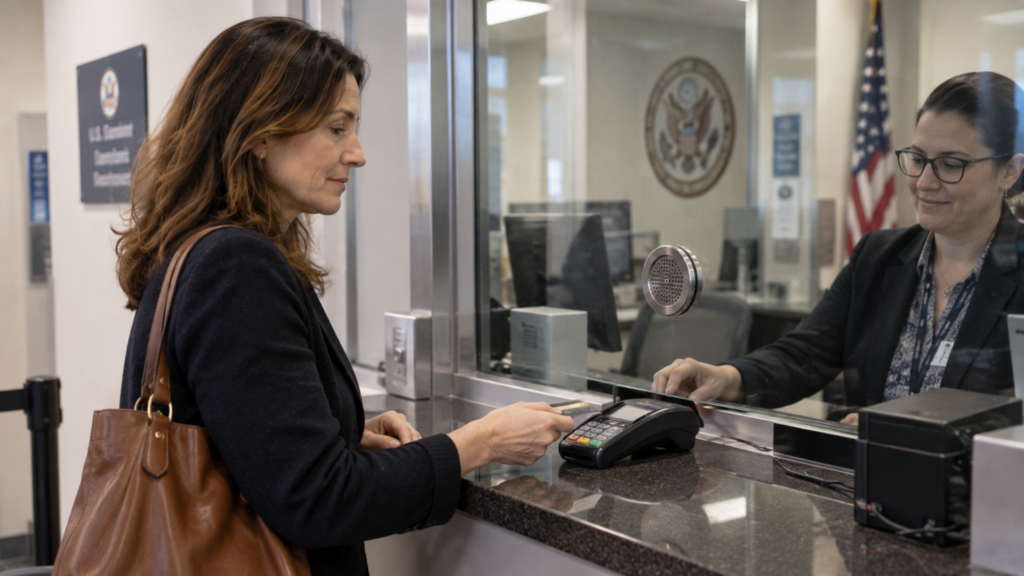
Renouncing citizenship remains a formal, multi-step legal process regardless of someone’s underlying motivation. Applicants must complete State Department forms, attend an in-person interview at a U.S. embassy or consulate, and take a formal oath before an officer can approve the request. The State Department warns the decision could leave someone stateless and may bar reentry if officials determine the renunciation was made specifically to avoid U.S. taxes.