

Products are selected by our editors, we may earn commission from links on this page.
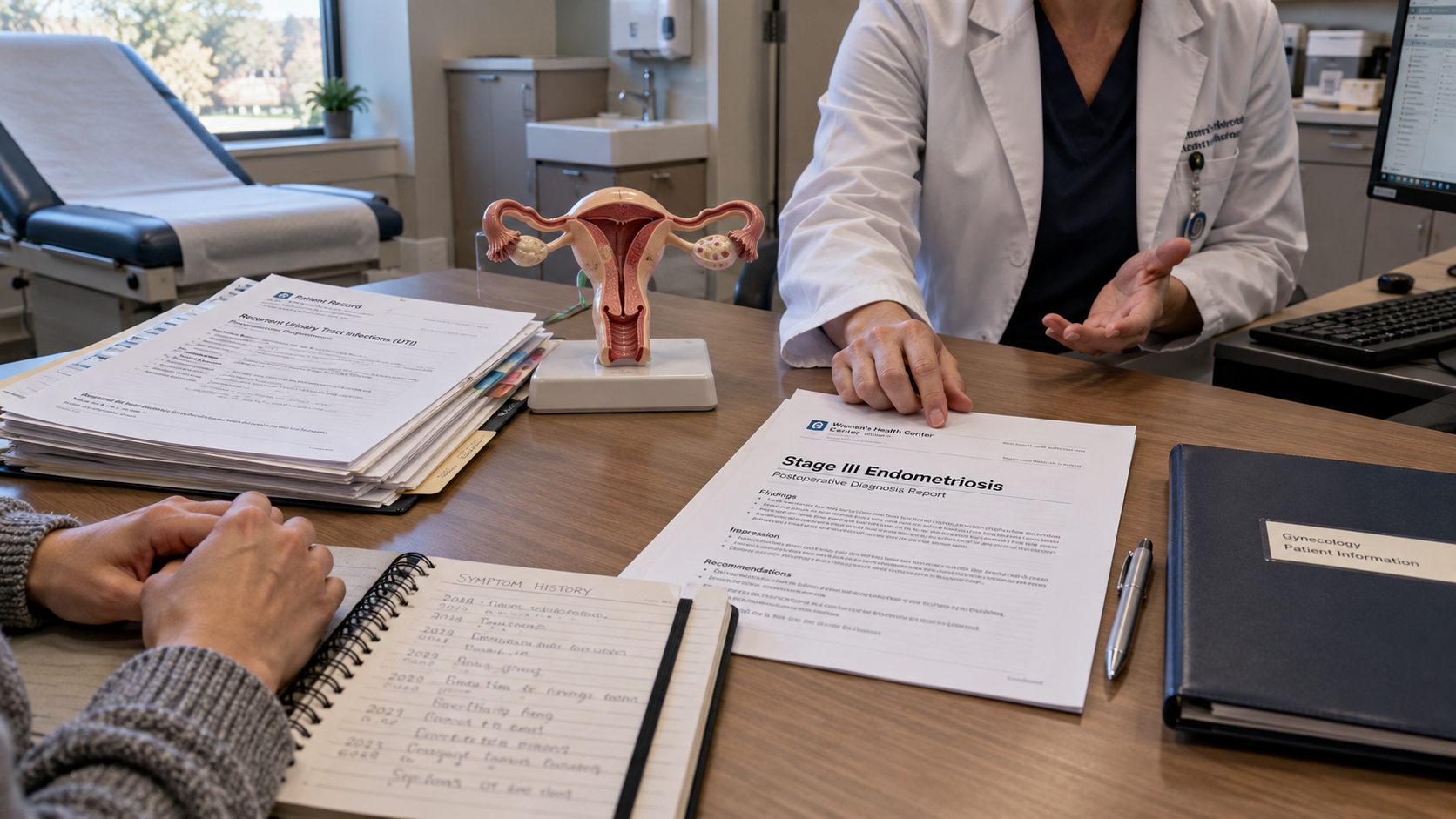
Shannon Tsonis was told for roughly two decades that she had recurring urinary tract infections. The real cause was stage three endometriosis, found only when a surgeon opened her abdomen during a total hysterectomy and looked. The lesions were on her bladder, which explained the burning urination that had sent her to urgent care clinics since her early twenties. Scar tissue and adhesions ran through her groin, over her right hip, and down into her lower back at the sacrum. That map matched the pain she had been describing to doctors for years. “It was everywhere you said it was,” the surgeon told her afterward, according to her account. “I’ve never had a woman be wrong about her pain.”
This article was created with the assistance of AI and reviewed by our editorial team for accuracy and clarity.
The test used to rule it out cannot rule it out

Before the surgery, Tsonis saw a physician described to her as one of the leading endometriosis specialists in her area. She asked him directly whether she had endometriosis. He said she did not, and explained his reasoning: he had measured her endometrial lining and found it within the normal range. Women with endometriosis, he told her, show a thickening of that wall. Her surgery contradicted that. Endometriosis is defined by tissue resembling the uterine lining growing outside the uterus, which is why a measurement of the lining inside the uterus says nothing reliable about whether lesions exist elsewhere. Tsonis left that appointment relieved and still without a cause for her pain.
Only surgery confirms it, which is why it takes years

There is no blood test or scan that definitively diagnoses endometriosis. Confirmation requires exploratory surgery, usually laparoscopy, where a surgeon looks directly for lesions. Everything before that is a process of elimination, with clinicians ruling out other explanations one at a time. That structure helps explain the delay Tsonis experienced. Diagnosis commonly takes up to ten years from the onset of symptoms. During that window the symptoms still need managing, so patients cycle through treatments aimed at whatever the current working theory is. Tsonis spent her twenties and thirties inside that loop. The condition can cause severe pain, infertility, digestive problems, chronic inflammation, and organ damage, and it is often mistaken for IBS, recurring infections, anxiety, or difficult periods.
More than $15,000 in a single year, before surgery

In one year alone, Tsonis estimates she spent over $15,000 on prescriptions, testing, supplements, and specialist appointments. That figure covers the search, not the answer. The answer came later, in an operating room. The spending reflects how far she went looking. She saw a urologist, a urogynecologist, and a gastroenterologist, and paid for boutique work including vaginal microbiome analysis. She had rounds of blood tests, repeated physical exams, and pelvic floor therapy. Near the end she tried a GnRH antagonist, a drug used for moderate to severe endometriosis pain, prescribed as a diagnostic experiment: if the pain eased, the diagnosis was probably endometriosis. It cost over $100 a month. After two months she had no relief.
At least a dozen antibiotics over two decades

Tsonis lists the drugs she was prescribed across twenty years: Cefdinir, Cephalexin, Minocycline, Amoxicillin, Nitrofurantoin Mono, Fosfomycin, Bactrim, Tetracycline, Cipro, Doxycycline, Sulfamethoxazole, and long-term Methenamine. By the end of 2024 she had built resistance to Bactrim and Tetracycline, and could no longer be prescribed either. She describes her gut health deteriorating and her immune system weakening over the same stretch. Many of the prescriptions came after urine tests that showed bacteria below the threshold normally used to call something a urinary tract infection. The doctor would note that, then prescribe anyway. She took them on that basis for years, through urgent care visits roughly four times annually in her early twenties.
Antibiotics worked, for a reason nobody explained

The most confusing part of the pattern was that the antibiotics helped. Tsonis would feel better for a couple of weeks after starting a course, then drop back into deep discomfort. That apparent response reinforced the UTI theory every time it happened. She learned later that the relief likely came from the drugs reducing inflammation in her body rather than clearing any infection, which eased most of the symptoms without touching the cause. This is the trap in a treat-and-see approach. A treatment that produces partial, temporary improvement can look like confirmation of the diagnosis behind it. In her case, each round of improvement was evidence that the wrong answer was working, and so the question stayed closed for another few weeks.
Women are prescribed more antibiotics than men

The prescribing pattern Tsonis describes is not unique to her file. Research has found that women receive roughly 27 percent more antibiotic prescriptions than men over a lifetime. She cites this in explaining why her own stack of prescriptions felt routine to the clinicians writing them. She points to a second documented tendency alongside it: women’s symptoms are more likely to be attributed to stress or anxiety. Gynecological pain, she argues, gets minimized, normalized, or routed into treatments that manage symptoms without examining the cause. Her own experience fit that shape. Her sexual history was examined first at nearly every visit, and she was routinely tested for sexually transmitted diseases despite being in a long-term monogamous relationship.
The cyst that was found and set aside
In 2024 a CT scan ordered by her urogynecologist showed a large cyst on one of her ovaries. That finding sent her to the endometriosis specialist for a pelvic ultrasound. He measured the cyst, judged it too small to operate on, and told her it would likely resolve on its own. The visit produced a measurement and a reassurance, and the underlying question went unanswered. Days later the familiar pain returned and she was back at the urogynecologist asking for more antibiotics. This is the shape her search kept taking: an imaging result would surface something, the something would be assessed in isolation, and the pain would continue on its own schedule regardless of what had just been measured or dismissed.
Stage three, and surgery that is likely to repeat

The surgeon classified her disease as stage three, meaning endometrial-type tissue had grown outside the uterus and created adhesions, but had not invaded her organs. Organ involvement is stage four, the most difficult to treat. The classification carries a practical consequence. Eradicating all endometriosis at stage three is unlikely, and Tsonis was told a second removal surgery within five years is probable. Her hysterectomy removed her uterus but left both ovaries in place, so her body continues producing the estrogen that may have driven the disease in the first place. The cause of endometriosis remains unsettled. Proposed explanations include retrograde menstruation, genetic predisposition, hormonal influence, immune dysfunction, environmental exposure, and metaplasia.
One in ten women, and a surgeon’s single sentence

An estimated one in ten women of reproductive age worldwide has endometriosis. When Tsonis posted her story on social media, messages arrived from women describing almost identical sequences: the pain, the infection diagnoses, the years. What stays with her is the surgeon’s remark that she had never had a woman be wrong about her pain, delivered after an operation that removed an organ to settle a question. Tsonis describes feeling relief and anger simultaneously. The hysterectomy restored quality of life she had not had in years. It did not return the two decades, the resistance she built to two drugs, or the money. If pelvic pain and recurring infection symptoms persist despite repeated treatment, the diagnostic path runs through a surgeon, not another urine culture.