


Products are selected by our editors, we may earn commission from links on this page.

Forgetting why you walked into a room can feel unsettling. So can the name that arrives five minutes too late. But getting older does not mean the brain simply clocks out. Research on adults over 60 suggests it can remain remarkably responsive to the right kinds of stimulation. And no, that doesn’t necessarily mean downloading another “brain training” app. Some of the activities researchers have studied look almost ridiculously ordinary. What separates the promising ones from simple ways to pass an afternoon is the interesting part.
This article was created with the assistance of AI and reviewed by our editorial team for accuracy and clarity.
Being Busy Isn’t Necessarily Enough
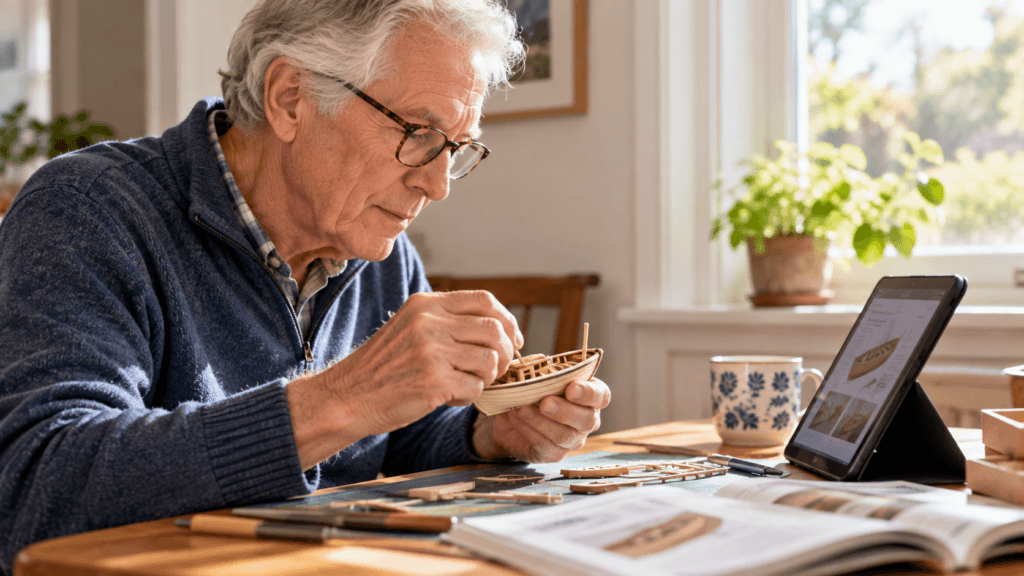
A packed calendar can keep life interesting, but researchers have found that simply staying occupied may not provide the same cognitive challenge as learning something difficult. Neuroscientist Vonetta Dotson puts it simply: “Many hobbies…challenge your mind, which strengthens the brain’s ability to adapt and build new connections.” The recurring theme is novelty, effort and sustained attention, sometimes mixed with movement or social connection. So which hobbies actually put those ingredients together? The first one may be sitting in your pocket already.
1. Pick Up a Camera and Be Bad at It

Digital photography sounds leisurely. Learning it from scratch is another story. In research involving 221 adults ages 60 to 90, participants learning demanding skills such as digital photography improved on episodic-memory testing, while a social group spending comparable time together did not. The point wasn’t taking pretty pictures. It was wrestling with unfamiliar controls, techniques and decisions. The frustration was part of the workout. That also means your phone camera counts only if you’re actually pushing yourself to learn something new.
2. Learn an Instrument, Even If You Sound Terrible

Never touched a piano? Good. In a trial of 155 adults ages 60 to 80, participants receiving group piano lessons for 16 weeks improved in verbal fluency and measures of executive function compared with other groups, including computerized brain training. Playing forces the eyes, ears and hands to coordinate while the brain tracks rhythm and notation. TODAY cites research suggesting instruments strengthen connections among regions involved in hearing, timing and concentration. And if piano feels demanding, the next hobby adds your entire body to the assignment.
3. Dancing Makes Your Brain Keep Up

Dancing is sneaky exercise. Your heart is working, but so are memory, coordination, rhythm and attention. A study comparing older adults doing dance training with those doing conventional exercise found both groups showed hippocampal volume increases after 18 months, while only the dancers improved balance. Neuroscientist Wendy Suzuki calls dancing “one of the most powerful ways to boost brain health.” New routines force you to learn, remember and react while moving. Forget getting every step right. Trying to keep up is precisely what makes it interesting.
4. Don’t Retire the Crossword Yet

Crosswords may look old-school next to slick brain-training apps. They have some intriguing evidence behind them. Researchers studying older adults with mild cognitive impairment compared web-based crosswords with computerized cognitive games. After 78 weeks, the crossword group performed better on a standard cognitive measure and showed less brain shrinkage on MRI. The study did not include a no-activity control group, so it cannot prove crosswords beat doing nothing. Still, there’s something satisfying here: the newspaper puzzle gave the purpose-built software a serious fight.
5. Walking Is Doing More Than Clearing Your Head

No lessons. No equipment. Just walk. In a year-long study of 120 sedentary older adults, participants who worked up to roughly 40 minutes of walking three times weekly showed a 2% increase in hippocampal volume, while a stretching group showed a decline. The researchers described the structural change as effectively reversing one to two years of age-related volume loss, although interpretation of the memory results was more complicated. Walking with someone adds another ingredient too: conversation. Sometimes the least glamorous hobby earns its place anyway.
6. Volunteer Where People Actually Need You

Volunteering gets especially interesting when it requires more than showing up. The Baltimore Experience Corps trial placed older adults in elementary schools, where they had schedules, children’s names, lessons and responsibilities to remember. In brain scans from a subset, men participating in the program showed increases in brain volume over two years while controls lost volume. Other research also links formal volunteering with working memory and processing benefits. Purpose feels good. Having people count on you makes your brain work.
7. Read It, Then Write Something

Here’s permission to keep buying books. Researchers followed 294 older adults through annual memory testing and later examined their brains after death. People reporting frequent late-life mental activity, especially reading and writing, experienced slower cognitive decline than those with average activity. Intriguingly, the association remained after researchers accounted for Alzheimer’s-related plaques and tangles. That does not prove reading prevented disease. It suggests mentally active people may have functioned better despite brain pathology. Journals, letters and notes count too. Nobody said your writing has to win a Pulitzer.
The Best Hobby May Be the One You Haven’t Mastered

There’s a catch hiding across these studies: comfort may be the enemy of challenge. Photography worked when people had to learn. Piano demanded unfamiliar coordination. Dancing required changing routines. Crosswords forced retrieval. Walking challenged sedentary bodies. Volunteering added responsibility. Reading and writing kept the mind engaged. Dr. Eva Feldman recommends combining physical exercise, mental challenges and social interaction when possible, while experts also stress choosing something enjoyable enough to continue. So don’t obsess over finding the perfect hobby. Pick something you’d actually do, then keep making it a little harder. Which one would you try first?