


Products are selected by our editors, we may earn commission from links on this page.
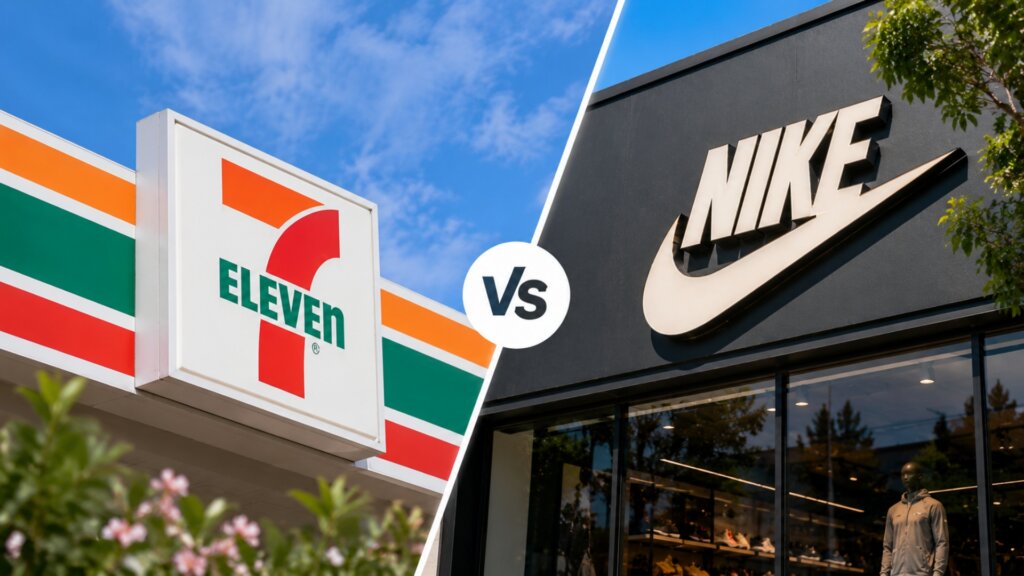
Nike planned to drop a new sneaker on July 11. That date is not random. It is 7-Eleven’s birthday, celebrated every year as Free Slurpee Day. Days before launch, 7-Eleven filed a federal lawsuit accusing Nike of copying its exact orange, green, and red stripe pattern, a design the chain has trademarked for nearly 60 years. The convenience store giant wants the sneakers pulled and destroyed before they ever reach shelves.
The shoe in question is the Nike Air Max 95 Big Bubble, listed in a “Sport Green and Safety Orange” colorway. According to the lawsuit filed in the Northern District of Texas, the side stripes run in the same order as 7-Eleven’s tri-color mark. Some online sellers had already nicknamed it the “7-Eleven shoe” before the suit was filed, a detail 7-Eleven’s attorneys used as direct evidence that shoppers were already making the connection Nike never officially made.
7-Eleven says the confusion goes deeper than color. The lawsuit points to a graphic of convenience store shelves printed on the shoe’s insole, along with a line in Nike’s own product description referencing “strolling down to the corner store.” None of it credits 7-Eleven by name. All of it, the retailer argues, was designed to evoke one specific store chain without ever asking permission or paying for the association.
This article was created with the assistance of AI and reviewed by our editorial team for accuracy and clarity.
A Trademark Nike Never Licensed

This is not 7-Eleven improvising a color story. The company has used its orange, green, and red combination on signage, uniforms, cups, and merchandise for decades, and it has licensed the look before. In 2022, 7-Eleven partnered officially with Crocs on a branded shoe. It has also worked with skate brand DGK. Those deals, the lawsuit notes, prove the tri-color mark carries real commercial value, and that value depends on Nike not giving it away for free.
Nike and 7-Eleven were not always on opposite sides of a courtroom. Back in 2020, the two companies had built an official Nike SB Dunk Low collaboration timed to the Tokyo Summer Olympics. When the Olympics were postponed to 2021, that release quietly disappeared and never came out. That earlier, sanctioned partnership is exactly what makes this unauthorized version sting more for 7-Eleven’s legal team.
Court filings claim 7-Eleven tried to settle this before suing. The retailer says it reached out to Nike repeatedly, asking the company to change course ahead of the July 11 release. Nike’s response, according to the complaint, was that it intended to keep advertising and selling the sneakers as planned. That refusal is what pushed 7-Eleven from private phone calls into a Dallas federal courtroom.
“Malicious Intent,” 7-Eleven Alleges
“Nike’s infringement is a deliberate and willful effort to associate its footwear with 7-Eleven by copying or imitating the Tri-Color Mark,” the lawsuit states. 7-Eleven goes further, accusing Nike of acting with “malicious intent” and “knowing disregard” for its trademark rights. Those are not throwaway legal phrases. They signal 7-Eleven is pushing for enhanced damages, the kind courts reserve for infringement judged intentional rather than accidental.
7-Eleven is asking for more than an apology. The lawsuit demands Nike stop manufacturing, marketing and selling the Air Max 95 entirely, and that existing pairs plus any promotional materials be destroyed. On top of that, 7-Eleven wants Nike’s profits from the shoe handed over, along with damages and attorney fees. No dollar figure has been made public, but the list of demands reads like a company trying to erase the sneaker completely.
The lawsuit already changed the sneaker’s fate before a judge ruled on anything. Nike quietly pulled the Air Max 95 Big Bubble from its SNKRS app listings after the filing became public. Meanwhile, resale prices on secondary sneaker sites more than doubled once news of the dispute spread, turning a shoe Nike may never officially sell into one of the most searched releases of the summer.
A Birthday Nike Wasn’t Invited To
7-Eleven addressed the timing directly in a public statement, saying it acted because of “the unauthorized use of our brand along with the impending launch in a matter of days on our birthday.” For a chain that turns its own founding date into an annual promotion, watching a rival company plan a colored sneaker drop on that exact day left little room for a quiet resolution.
Legal experts note that color combinations rarely qualify for trademark protection unless a company can prove the public already links that palette to its brand alone. 7-Eleven’s near-60-year run with orange, green, and red, paired with existing federal registrations, gives its case real weight in court. Nike has not filed a public response, and the Air Max 95 remains off its official release calendar for now.
Two companies that once planned an official sneaker together are now fighting over one neither side authorized. Nike built a shoe around imagery that evoked a convenience store without naming it, and got sued the moment shoppers filled in the blank Nike left open. Whatever a judge eventually decides, the case is already a lesson in how far a color scheme alone can travel through a courtroom.