

Products are selected by our editors, we may earn commission from links on this page.
The U.S. military is running low on weapons, and the Pentagon is now asking car companies to help fill the gap. Senior defense officials have held talks with the chief executives of both Ford and General Motors about shifting factory capacity toward military production, according to the Wall Street Journal. If it moves forward, this would mark the first time major commercial manufacturers have been pulled into the American war machine since World War II, a moment that defined the country’s industrial identity.
The conversations come as simultaneous conflicts in Iran and Ukraine have placed an extraordinary strain on America’s weapons stockpiles. Since the U.S. and Israel launched coordinated strikes on Iran in February, military supplies have depleted at alarming rates. A Center for Strategic and International Studies analysis found that in a single 12-day window of the Israel-Iran conflict in June 2025, the U.S. fired roughly 150 THAAD interceptors, approximately one quarter of every such missile the Pentagon has ever purchased.
The depletion is not a new problem, but the speed at which it is worsening is. Concerns about shrinking stockpiles first surfaced in 2022 after the U.S. transferred significant weapons supplies to Ukraine following Russia’s full-scale invasion. What is new now is the scale of the response being considered, one that reaches beyond the traditional defense industry and into the parking lots and assembly lines of Detroit.
An Empty Arsenal and the Case for Detroit
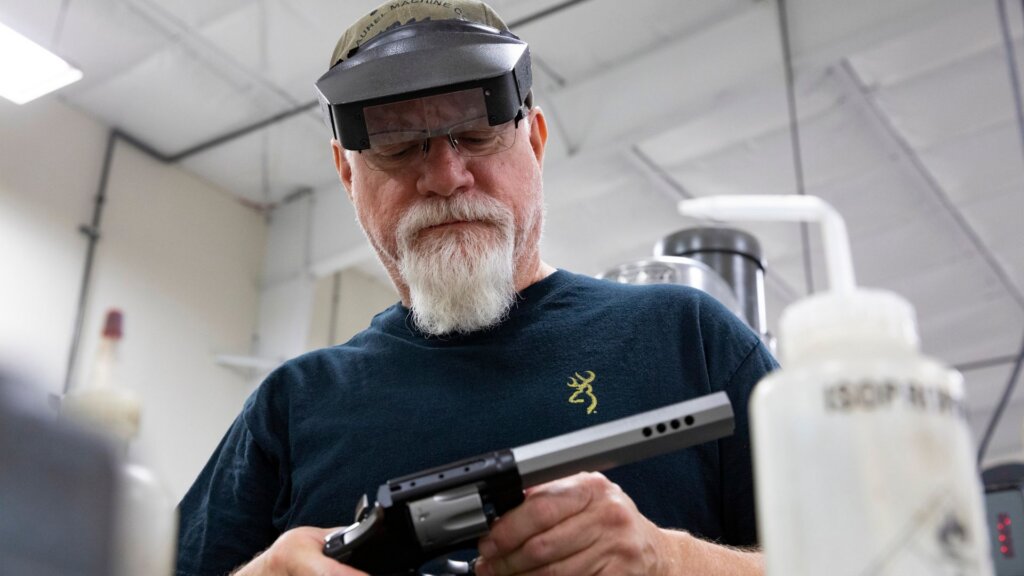
America’s defense manufacturing base was already under serious stress before the latest conflicts began. An April 2025 report from the Center for a New American Security concluded that the U.S. defense industrial base was “insufficient to meet the demands of modern warfare,” citing decades of underinvestment, slow production timelines, and unpredictable demand signals. The system built largely for peacetime deterrence was simply not designed to sustain two simultaneous military campaigns of this scale.
In response, the Trump administration has moved on multiple fronts. President Donald Trump signed an executive order aimed at expanding domestic munitions capacity, and the administration submitted a proposed defense budget of $1.5 trillion for fiscal year 2027, the largest single-year Pentagon funding request since World War II. The Pentagon also released its Acquisition Transformation Strategy in November 2025, laying out a blueprint for shifting weapons manufacturing toward a wartime pace.
Yet budgets and executive orders take time to translate into production. Commercial manufacturers offer something the traditional defense supply chain currently cannot: spare capacity. Ford’s U.S. factories are projected to operate at 73% capacity in 2026, while General Motors sits at roughly 79.5%. That slack, combined with massive workforces and advanced automation, is precisely what drew Pentagon officials to the automakers’ boardrooms in the first place.
What Detroit Built Before, and What It Could Build Again
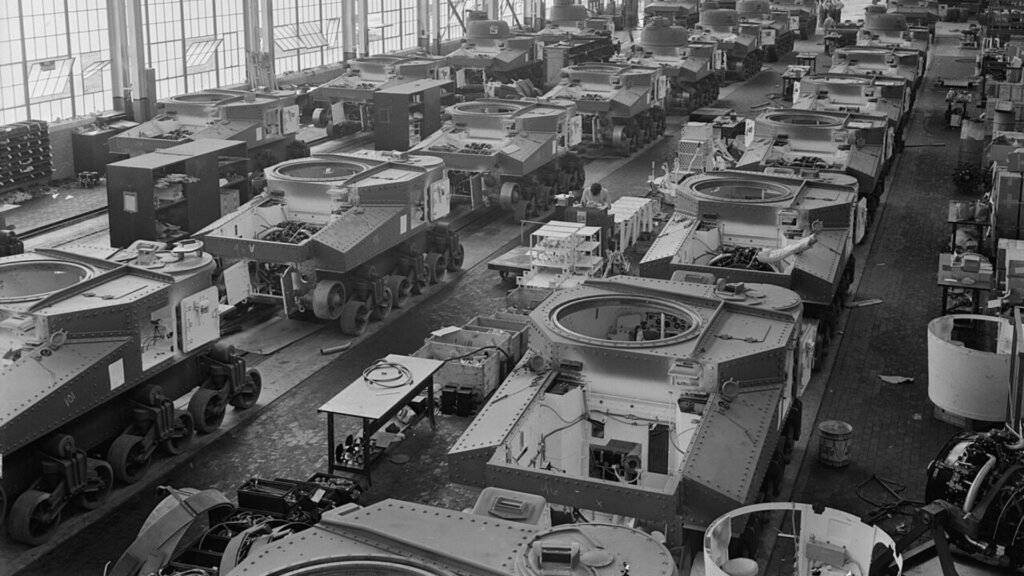
The last time the U.S. government called on Ford and GM this directly, the result was nothing short of industrial legend. During World War II, Detroit earned the title “Arsenal of Democracy,” a phrase coined by President Franklin D. Roosevelt to honor the city’s transformation from car capital to war machine. Ford’s Willow Run plant was producing one B-24 bomber every hour by the summer of 1944, according to the Detroit Historical Society. General Motors was responsible for the single largest share of total American munitions output during the war.
The scale of that effort was staggering. Detroit-area factories supplied 91% of all Army helmets used in the war. A single Michigan plant produced half of all U.S. tanks. Beyond armored vehicles, Ford built jeeps, military trucks, aircraft engines, and precision-machined components, while GM manufactured everything from aircraft engines to machine tools and weapon parts. The retooling happened fast, and it happened because the manufacturing infrastructure was already in place, waiting to be redirected.
Today’s situation differs in crucial ways. Modern weapons systems rely on sensitive electronics, classified materials, and tightly controlled production environments that commercial car plants are not built to handle. What the Pentagon appears to be looking at is more targeted: transportation vehicles, mechanical components, and supply chain support rather than frontline weapons. GM already operates a defense arm that produces infantry carriers and armored vehicles for the Army, giving it a clearer path into expanded military work than Ford, which exited the defense business entirely in the 1990s.
No Contracts Yet, but the Clock Is Ticking
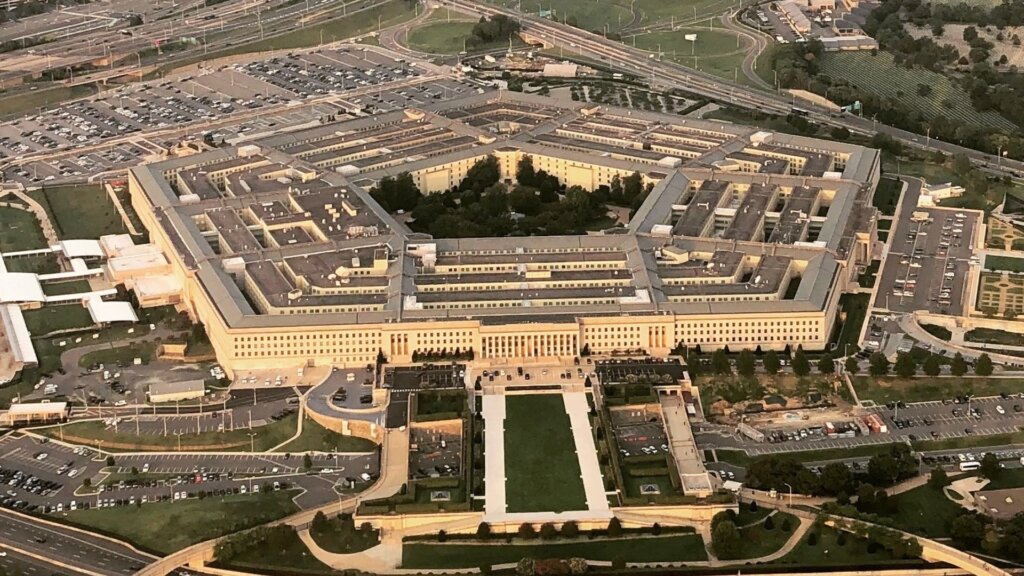
The Pentagon has not invoked the Defense Production Act, the law that would allow the federal government to legally compel private companies to manufacture goods critical to national security. The discussions remain preliminary, with no contracts announced and no public commitments from either automaker. Ford declined to comment when contacted by multiple outlets. GM offered only a carefully worded statement acknowledging its long history of supporting national defense, while declining to address the specifics of the talks.
What is not ambiguous is the pressure building behind the conversations. Deputy Defense Secretary Stephen Feinberg raised the prospect of drawing automakers into the defense industrial base directly with company executives. The Pentagon’s own statement to Newsweek said the Department of Defense “is aggressively pursuing and integrating the best of American innovation, wherever it resides, to deliver production at scale.” That is not the language of routine procurement. It is the language of urgency.
Whether Ford and GM ultimately sign on, the fact that these conversations are happening at all signals something significant about where the United States finds itself in 2026. The country’s military commitments have outpaced the industrial capacity built to support them, and the gap is widening. The deeper question is not whether automakers can help build parts for the next war effort. It is whether the richest country in the world allowed its defense manufacturing to hollow out so thoroughly that it now needs to rediscover an answer it first found eighty years ago.