


Products are selected by our editors, we may earn commission from links on this page.

A paralyzed man has become the first person to operate an iPad using only his thoughts. The breakthrough arrived through a Bluetooth-enabled brain implant that translates neural signals into digital actions. His experience marks a turning point for assistive technology built for people with severe physical disabilities.
Mark Jackson was diagnosed with amyotrophic lateral sclerosis (ALS) in 2021, losing movement in his arms and developing weakness in his neck. Like many living with ALS, he feared the gradual loss of autonomy that often comes with the disease.
ALS and the Challenge of Everyday Tasks

ALS is a nervous system disease that damages motor neurons, causing muscles to weaken and stop functioning. Over time, people with ALS may struggle to walk, speak, swallow, and breathe, while their senses remain intact.
To help restore access to digital tools, neurotech company Synchron developed an implantable brain-computer interface called the Stentrode. Instead of open brain surgery, doctors inserted the device into a blood vessel within the brain in a minimally invasive procedure.
The implant reads Mark’s neural activity when he imagines movement, sending that data to a unit in his chest. That device decodes the signals and transmits commands to an iPad via Bluetooth, functioning like a wireless input system.
Apple’s New Native Brain Control
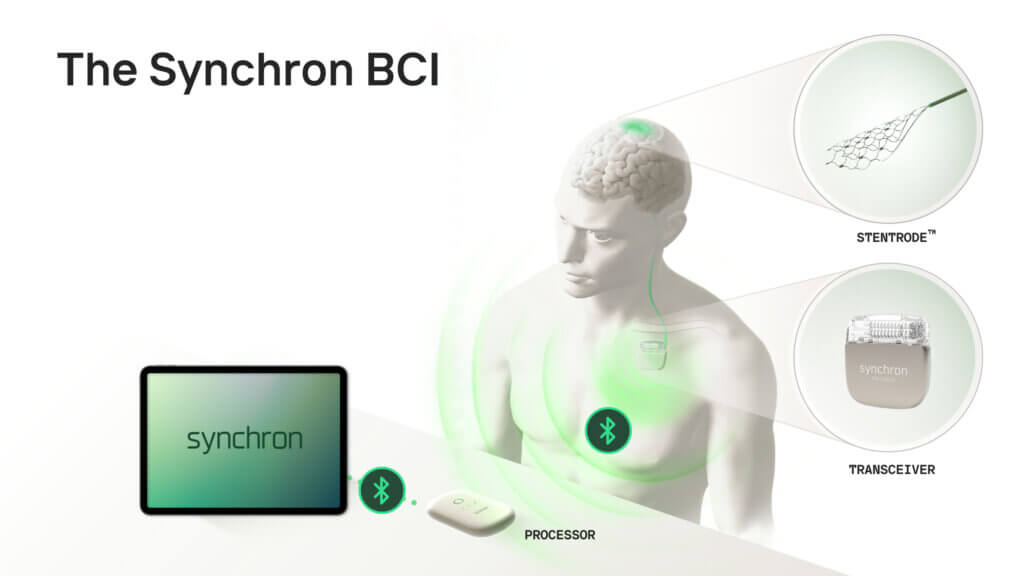
The demonstration uses Apple’s new Brain-Computer Interface Human Interface Device protocol, which allows iPadOS to treat neural signals as a native input method. With Switch Control built into the operating system, Mark can browse the home screen, open apps, and type messages entirely by thought.
Unlike earlier BCI systems that mimicked mice or keyboards, the new protocol enables two-way communication. The iPad shares contextual screen data with the implant’s decoder, helping refine accuracy in real time and making navigation feel more intuitive.
Mark now watches TV shows, listens to audiobooks, uses social media, and messages his children without needing his hands. He describes the ability to do these small tasks as a form of freedom, noting that technology has given him “part of [his] life back.”
Questions Still Unanswered
Synchron’s public test marked the first native thought-based control of an Apple device. The company continues controlled rollouts with clinical participants, seeing the result as a glimpse of how brain-driven input could become mainstream.
Experts say BCI adoption raises concerns about long-term safety, data privacy, and regulatory approval. Neurologists caution that large-scale trials will be needed to understand how many people can benefit and how to protect their neural data over time.