


Products are selected by our editors, we may earn commission from links on this page.

If your face still looks youthful but your neck tells a different story, you’re not imagining it. Dermatologists say the neck is one of the most overlooked areas in skincare, even though it’s just as visible as the face. “I see so many cosmetic patients whose faces look amazing, but whose necks look…different,” says board-certified dermatologist Kristina Collins, MD. The good news is that neck aging has clear, well-understood causes, and several effective ways to address it that do not involve surgery. Understanding why this area shows age first makes it much easier to treat.
This article was created with the assistance of AI and reviewed by our editorial team for accuracy and clarity.
The Neck Has Almost No Fat or Oil Glands

Board-certified dermatologist Marisa Garshick, MD, explains that neck skin has a thinner dermis and far less fatty tissue underneath than the face does. That structural difference makes it more prone to wrinkling and sagging in the first place. The area also has fewer oil glands than facial skin, leaving it drier and more susceptible to fine surface lines. On top of that, neck muscles are strong and rarely rest. Over years of constant use, they gradually pull down on the lower face, contributing to jowls and loosening skin along the jawline.
Your Phone Habit Is Etching in New Wrinkles

Dermatologist Alexandra Bowles, MD, points to a newer culprit behind neck aging: constantly looking down at screens. The repeated downward angle creates horizontal creases across the neck, a pattern often nicknamed tech neck. Just like facial expression lines, repeating the same muscle movement over and over eventually turns a temporary crease into a permanent one. Bowles notes these lines have always existed, but they are showing up earlier and more visibly now because so many people, including younger generations, spend hours a day hunched over devices.
Most People Skip Sunscreen on This One Spot
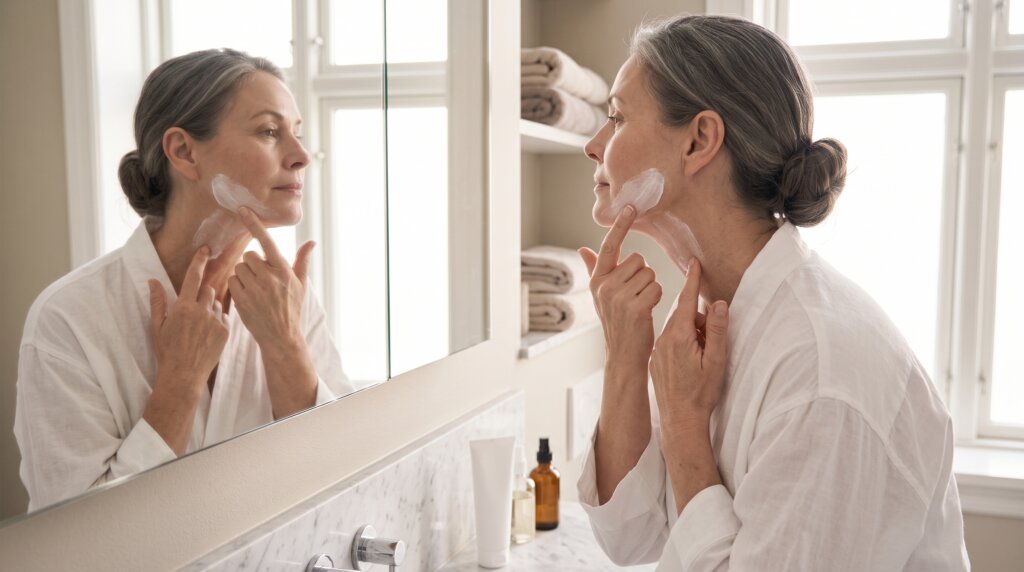
Dermatologist Kristina Collins, MD, says a simple habit gap is a major driver of neck aging: many people apply sunscreen and anti-aging products faithfully to their face but stop at the jawline. UV exposure is a leading cause of collagen breakdown, uneven tone, and skin laxity. The fix does not require a special product. Garshick notes that whatever sunscreen or serum you already use on your face can simply be applied downward onto the neck, making this one of the easiest changes to fold into an existing routine.
Almost Any Face Serum Can Do Double Duty

Dermatologists agree that most anti-aging ingredients formulated for the face work just as well on the neck. That includes vitamin C for protecting against free radical damage, peptides and growth factors for firming, and hydrators like hyaluronic acid and glycerin. Collins says a separate neck-specific product usually is not necessary, since most face formulas are gentle enough to extend downward. The one ingredient that deserves more caution is retinol, which can be more irritating on thinner, drier neck skin than it is on the face.
Retinol Needs a Slower Pace on the Neck

Retinoids are valued for their collagen-boosting effects, but Bowles warns that the neck’s lack of oil glands makes it more prone to dryness and irritation from these ingredients than the face is. Rather than skipping retinol altogether, her advice is to scale back frequency. Using it once or twice a week, instead of nightly, allows the neck to build tolerance while still gaining some firming benefits. This small adjustment reflects a larger point dermatologists make often: neck skin can handle many of the same ingredients as facial skin, just at a gentler pace.
A Dedicated Neck Cream Is Optional, Not Essential

For people who want an extra step, a neck-specific cream can be a convenient way to combine multiple beneficial ingredients in one formula built for that area’s needs. Bowles points to options like SkinMedica’s Neck Correct Cream, while Collins favors Revision’s Nectifirm. Garshick also notes that certain at-home devices, including microcurrent tools and LED light therapy masks, may help stimulate circulation and temporarily firm the area with consistent use. None of these replace in-office treatments, but they can be a useful addition for people not ready for a professional procedure.
In-Office Treatments Target Deeper Layers

For more noticeable firming, dermatologists turn to treatments like Sofwave or radiofrequency microneedling, both of which heat the deeper skin layer to encourage new collagen production. Injectable biostimulators such as Sculptra and Radiesse work through a similar collagen-building mechanism. For people primarily concerned with uneven pigmentation rather than laxity, resurfacing lasers or intense pulsed light treatments tend to be more effective. Each option targets a different concern, which is why an in-person evaluation matters more than picking a treatment based on what worked for a friend.
Why the Neck Requires a Gentler Hand Than the Face

Neck skin scars more easily than facial skin, so the same energy-based devices used on the face often need lower settings on the neck. Collins stresses that this makes provider experience especially important. A treatment producing excellent results on the face could cause complications on the neck if settings are not adjusted appropriately. For muscle-related lines from tech neck, neurotoxin injections that relax the platysma muscle tend to work better than topical products, though the larger muscle area typically requires more units, and cost, than facial treatment does.
The Takeaway: Small Habits Add Up Over Time

None of these steps require surgery, and most start with something already sitting in your bathroom cabinet. Extending daily sunscreen and a few key serums to the neck addresses the biggest driver of visible aging in the area. Adjusting retinol frequency protects against irritation while still building collagen. When more noticeable firming is the goal, energy-based treatments and neurotoxin injections offer options beyond what skincare alone can achieve. The consistent theme from dermatologists is that the neck ages differently than the face, but it responds well once it gets the same level of attention.