

Products are selected by our editors, we may earn commission from links on this page.
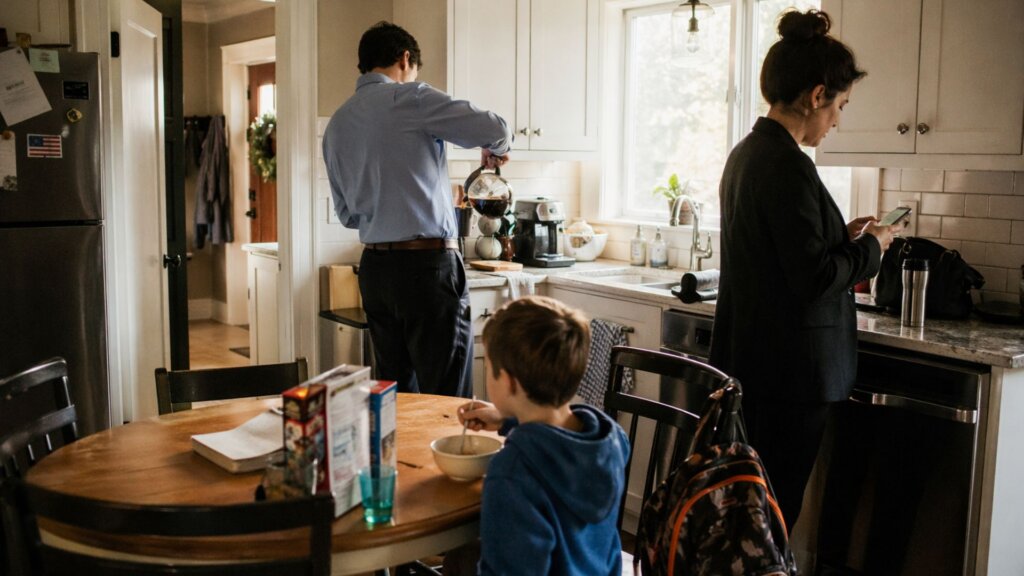
Even six-figure earners say living on a single paycheck feels “nearly impossible,” according to a recent survey by The Harris Poll. That is not a complaint from the fringe of the economy. It is the new normal. The version of the American Dream built on one working parent, a home, a car, and a retirement plan has effectively become a relic. What replaced it, experts say, is harder, more expensive, and shared by two.
In roughly half of all married-couple households today, both spouses hold jobs, according to 2024 data from the Bureau of Labor Statistics. In families with children, that figure rises to two-thirds. The shift happened gradually, driven by economic pressure and cultural change alike. But the result is clear: for millions of American families, the question is no longer whether both partners will work. It is how they will manage it all at once.
According to Mark Hamrick, senior economic analyst at Bankrate, “Where there was a time in the U.S. when a married couple, with children, could get by with a single-wage earner in the house, those days are mostly vestiges of the past.” The forces behind that shift, rising costs, changing workplaces, and a transformed labor market, did not appear overnight. They built quietly over decades, and they are still building now.
The Price of Everything Has Outrun the Paycheck

The costs that once defined middle-class life, a home, health coverage, childcare, and a college education, have become significantly harder to absorb on a single income. Health insurance premiums for family coverage have climbed more than 25% since 2020, outpacing general inflation. Childcare and college tuition costs have each grown by more than 5% per year over the same period, also running ahead of most other household expenses. These are not small surcharges. For many families, they represent the difference between keeping up and falling behind.
Home prices rose 52% between January 2020 and December 2024, according to the Case-Shiller index, while grocery prices climbed 30% over the same period. Overall inflation grew 25%, but families feel the specific categories that jumped most sharply, not the broader average. A household earning $100,000 today holds roughly the same purchasing power as one earning $80,000 did in 2020. Wages simply have not kept pace with the things families spend money on most.
Nearly two-thirds of middle-class Americans said they were struggling financially and did not expect improvement, according to a 2024 National True Cost of Living Coalition survey. According to Elise Gould, senior economist at the Economic Policy Institute, the relentless rise in costs has forced families to dedicate more hours per household just to keep their heads above water. The pressure is not hypothetical. It is measurable, and it shows up in how families are now structured.
The Workplace Itself Has Become Less Reliable

Beyond the price of living, the nature of work has changed in ways that erode the stability single-income households depend on. According to Bankrate’s Hamrick, there has been a “fracturing of both job security and a sense of belonging” for workers across industries. That fracturing is not just emotional. It has real financial consequences for families trying to plan ahead with the income of one person.
The rise of gig work sits at the center of this shift. More Americans now earn income through platforms that offer no guaranteed hours, no employer-sponsored health coverage, and no traditional pension. According to Hamrick, “If you are part of the gig economy, there’s a tremendous amount of insecurity.” Fewer gig workers, and even many full-time employees, have a traditional pension today, leaving them increasingly responsible for funding their own retirement. That burden alone can make one income feel dangerously thin.
The national middle-income range in 2022 sat between approximately $56,600 and $169,800 annually for a household of three, adjusted for household size and local cost of living. But what those figures do not capture is the gap between earning enough to technically qualify as middle class and actually feeling financially secure. For a growing number of families, those two things no longer mean the same thing. And that gap is where the most difficult trade-offs live.
Women Are Reshaping What “Providing” Actually Means

The story of the dual-income household is not only one of hardship. It is also one of the expanding possibilities. In 2023, more than 4 in 10 working mothers were the primary breadwinners for their families, according to a Center for American Progress analysis of U.S. Census Bureau data. An additional 24% were co-breadwinners, together representing the majority of mothers in the workforce. Women are not simply filling a financial gap. In many households, they are carrying the largest share of the load.
According to Scott Winship, senior fellow at the American Enterprise Institute, “Women have a lot more opportunities than they used to have, and so they’re working longer, and they’re working for higher pay.” That shift, he notes, has fundamentally changed what a middle-class lifestyle looks like and what it requires. The dual-income household is no longer just an economic necessity. For many families, it reflects a deliberate recalibration of roles, ambitions, and expectations about who earns and who decides.
The transformation of the American household is still underway. Costs keep rising, workplace stability keeps shifting, and the definition of middle class keeps moving. What experts have not yet answered is whether policy, wages, and social infrastructure will ever catch up to the reality that families are already living. The two-income household solved an immediate problem. Whether it is a permanent solution or simply a bridge to something that has not been built yet remains an open question.