

Products are selected by our editors, we may earn commission from links on this page.

PDRN, short for polydeoxyribonucleotide, is a mix of DNA fragments taken from salmon trout or chum salmon sperm, and it has spread from Korean dermatology clinics onto serum labels. Dr. Macrene Alexiades, a board-certified dermatologist with an MD from Harvard Medical School and a PhD in genetics, says the ingredient runs into a wall before it can do most of what the marketing suggests. “Topically, these are very large molecules,” she says. “Anything above roughly 500 daltons is unable to cross an intact stratum corneum, and PDRN is orders of magnitude larger.” PDRN molecules measure 50 to 1,500 kilodaltons, with most between 80 and 200 kilodaltons.
This article was created with the assistance of AI and reviewed by our editorial team for accuracy and clarity.
The effects people buy it for require a needle

The counterintuitive part is that Alexiades is not disputing PDRN’s biology. She is disputing the delivery route. “Specifically, PDRN has a stimulatory effect on cell growth, which can be helpful in some circumstances of wound healing,” she says of the injectable form. That activity is documented. It simply happens when the material is placed under the skin rather than spread across it. What a serum containing PDRN can still do is narrower. “What a topical PDRN can do is hydrate and support the barrier, but its other effects are observed when it is administered by injection,” Alexiades says. “The science behind it is as an injectable.”
The 500 Dalton rule sets the ceiling
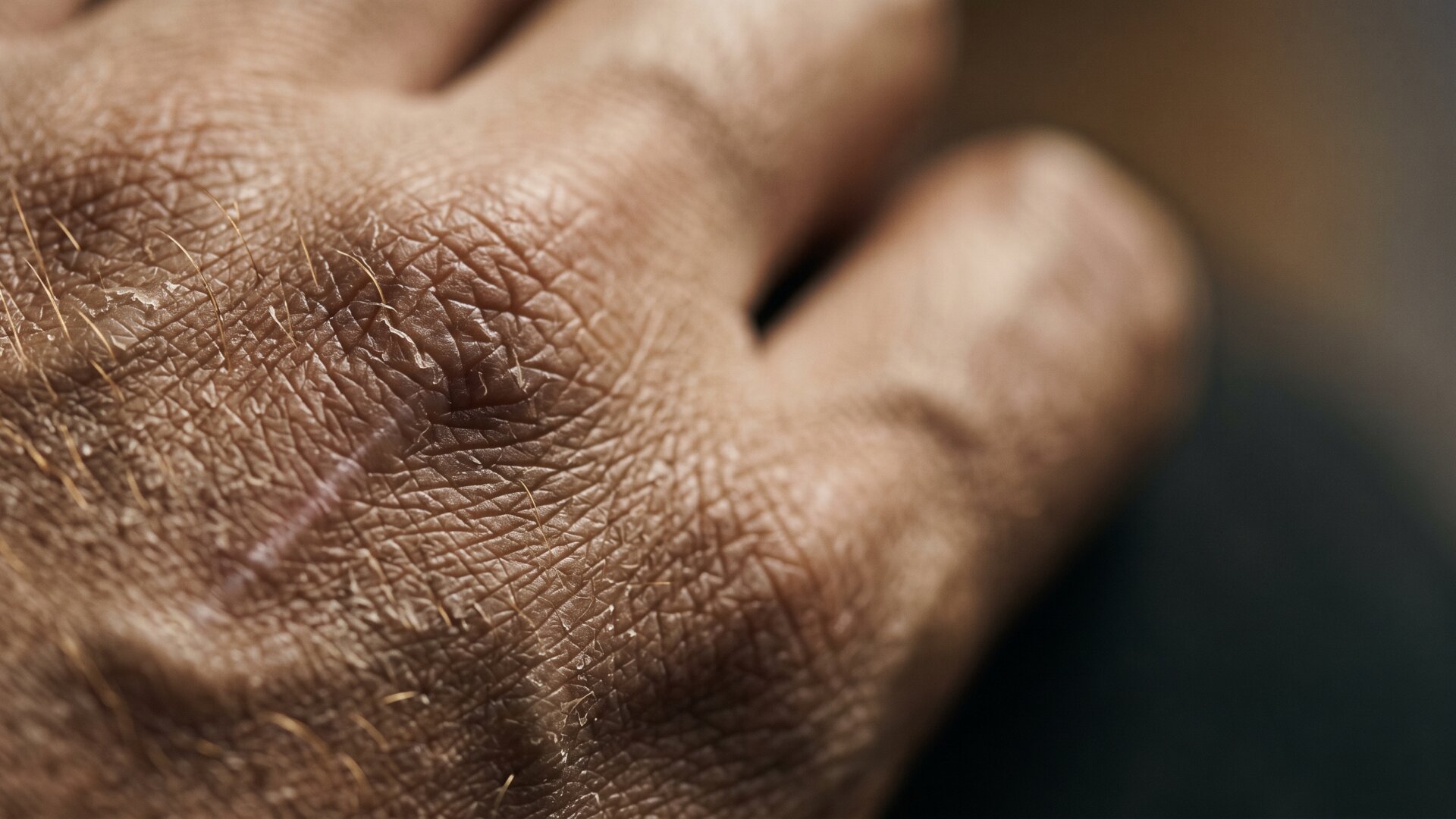
The stratum corneum is the skin’s outermost layer, a dense sheet of dead cells and lipids whose job is to keep foreign material out. A widely cited paper in dermatology established what is known as the 500 Dalton rule: a compound generally needs to weigh less than about 500 daltons to pass through healthy skin in any meaningful quantity. A dalton is a unit of molecular mass, roughly the weight of a single hydrogen atom. Most topical drugs that work through intact skin sit well under that threshold. PDRN does not sit near it. At 80,000 to 200,000 daltons for the bulk of its fragments, it is in a different size class entirely.
Two hundred thousand daltons against a 500 limit

The gap is worth stating as arithmetic rather than adjectives. If the practical ceiling for penetration is about 500 daltons, a PDRN fragment at the middle of its stated range is roughly 200 to 400 times heavier than the largest molecule that typically gets through. For comparison, hyaluronic acid used in skincare is often cited in the tens of thousands of daltons, which is why low molecular weight versions exist at all. Niacinamide weighs about 122 daltons. Vitamin C as L-ascorbic acid weighs about 176. The ingredients with the longest penetration track record are the small ones, and that is not a coincidence.
Exosomes and growth factors hit the same wall

PDRN is not alone in making the jump from clinic to cosmetics counter. Exosomes, the small packages cells use to send signals to one another, followed a similar path. Alexiades points to a different problem with those. “Exosome products have no standardized isolation, characterization, or dosing,” she says, “so two products with the same name can be entirely different.” Growth factors run into the size issue directly. She describes them as “large, fragile proteins that are difficult to stabilize and even harder to deliver through intact skin.” The human data that exist involve microneedling or radiofrequency microneedling, “which is a procedure, not a cream.”
One word she names as the most overhyped

Asked what is most oversold in skincare, Alexiades does not name a product category. She names a claim. “The word ‘regenerative’ on a topical product is the most overhyped,” she says. “It implies a biological result that most of these products have not demonstrated on skin.” Her position is not skepticism about the underlying science. “My PhD was in stem cell biology, and I am enthusiastic about this field,” she says. “But enthusiasm should follow evidence, not marketing.” In her Healio column on peptides, she grades evidence and flags safety concerns as separate categories, on the reasoning that an ingredient with real biological activity earns scrutiny in proportion to that activity.
What the ingredient list does not tell you
Shoppers have learned to read INCI lists, the standardized ingredient naming format printed on cosmetic packaging. Alexiades says those lists reveal “less than people think.” “Ingredients are listed in descending order of concentration only down to about 1 percent,” she says. “After that, the order can be anything.” An ingredient can also appear at a token amount with no measurable effect, and INCI naming frequently obscures where a material came from. “The list tells you what is in the bottle, not how much, in what form, at what pH, or how stable it is,” she says. “The label is where you start asking questions, not where you find the answers.”
The same ingredient can be inert in the wrong bottle

Penetration is not the only thing a formula controls. Alexiades uses vitamin C to show how far the same named ingredient can swing. “L-ascorbic acid needs a low pH to penetrate and oxidizes quickly when exposed to air and light, so the same ingredient in a poorly built formula in a clear jar is close to inert.” Retinoids and peptides depend on comparable variables: the specific form used, the concentration, the delivery system, and the vehicle carrying it. That set of decisions, she says, is “the difference between putting an ingredient on a label and formulating a product that works.”
Her ranking runs on years of human data

Alexiades orders ingredients by strength of evidence rather than novelty. Her list starts with daily broad-spectrum sunscreen, then topical vitamin C paired with vitamin E and ferulic acid, then niacinamide, then hyaluronic acid for hydration. Peptides make the list, specifically “well-studied peptides such as palmitoyl pentapeptide-4 and DNA repair ingredients.” She calls the vitamin C, vitamin E and ferulic acid combination the best-known synergy in skincare, because the pairing “stabilizes the vitamin C and enhances its photoprotective effect.” The dividing line she draws is duration. “Those are the ingredients with human data over years, not months. Everything beyond that is an addition to a foundation, not a replacement for it.”
Irritation is not evidence that something is working

One correction Alexiades makes carries a consequence beyond comfort. “Irritation is not a sign the product is working,” she says, “and in patients with deeper skin tones it can lead to lasting pigmentation.” Layering a retinoid with strong exfoliating acids or benzoyl peroxide can damage the barrier, and benzoyl peroxide can degrade tretinoin outright. Her formulating philosophy follows from the same reasoning. Skin ages across laxity, wrinkles, pigmentation, redness and keratoses at once, which is why she built the Alexiades Classification Scale to grade each separately, and why her formulas carry 37 classes of actives at high concentrations rather than one hero ingredient.