


Products are selected by our editors, we may earn commission from links on this page.

A company that holds billions in Pentagon contracts is now publicly pushing for every American to serve the military. Palantir Technologies, one of the most influential defense technology firms in the United States, published a 22-point manifesto on its X account that included a call for universal national service, arguing that society should “seriously consider moving away from an all-volunteer force.” The post racked up tens of millions of views within days, and the debate it ignited goes far beyond a social media moment.
The statement did not come out of nowhere. Palantir tied its position to “The Technological Republic,” a 2025 book co-authored by CEO Alex Karp and Nicholas Zamiska, which argues that Western democracies are weakening not because of external threats, but because Silicon Valley has distanced itself from the state and from civic responsibility. The manifesto, framed as a company belief system, presents the call for national service as a matter of shared obligation, not partisan politics. But critics read it very differently.
The timing of the post added another layer of tension. Palantir’s call came as the U.S.-Iran conflict entered its seventh week, a context that sharpened scrutiny of a defense contractor holding an estimated $10 billion Army deal now publicly lobbying for policy that would expand the pool of Americans eligible to fight wars its software helps run. That conflict of interest sat at the center of nearly every critical response.
The Company Behind the Manifesto

Palantir is not a household name, but its reach is extensive. Founded in 2003, the company builds data platforms used by governments, intelligence agencies, and militaries to process vast and complex datasets. Its tools are embedded in battlefield decision-making, logistics, and targeting operations across multiple conflict zones. Its platforms include Gotham, used by U.S. intelligence and defense agencies; Foundry, used by corporations for supply chain and data integration; and Apollo, which manages and deploys Palantir’s software across secure networks.
The company has also drawn sustained criticism outside the military context. Advocacy groups have long challenged Palantir for supplying software used by U.S. Immigration and Customs Enforcement. More recently, critics noted that Palantir is the recipient of roughly $2.4 billion worth of military contracts, raising pointed questions about whether a company that profits from war is a credible or neutral voice when calling on ordinary citizens to risk their lives in one.
The manifesto itself is adapted from Karp’s book and spans ideology far beyond the draft question. It calls for Silicon Valley to acknowledge a “moral debt” to the country that enabled its rise, argues that “hard power in this century will be built on software,” and insists that AI weapons development must proceed regardless of public debate. It also calls for the remilitarization of Germany and Japan, positions that, taken together, paint a portrait of a tech company that sees itself as a geopolitical actor, not just a software vendor.
What Universal National Service Would Actually Mean
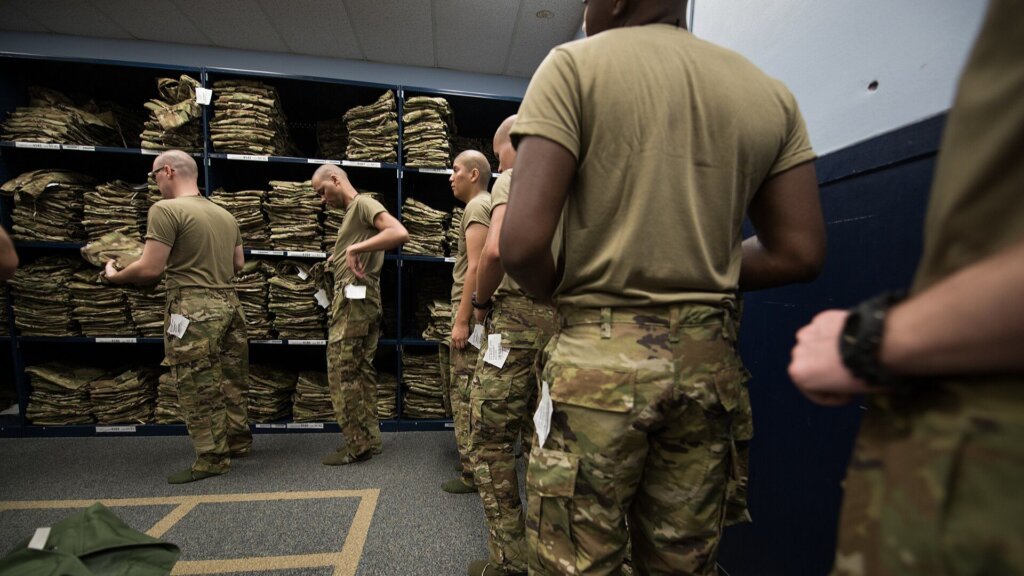
The phrase “universal national service” sounds abstract. In practice, it means requiring, or strongly encouraging, all young adults to spend one to two years in structured service to the country. That service does not have to mean carrying a rifle. Other options can include infrastructure work, environmental conservation, disaster response, public health support, or education. Some countries already operate hybrid systems that offer both military and civilian tracks, as Germany once did and Switzerland still does.
In the United States, a parallel development is already quietly underway. The Selective Service System moved toward automatically registering most draft-eligible men by December, following Congress authorizing the change in the fiscal 2026 National Defense Authorization Act. Eligible men ages 18 to 25 will be registered automatically into the military draft pool by the end of this year, a shift that transfers responsibility from the individual to the federal agency. Palantir’s post landed against this backdrop, making it feel less like a philosophical argument and more like a policy signal.
Supporters of national service argue it could address military manpower shortages while strengthening civic engagement across a fragmented country. But critics, including analysts at the Hoover Institution, contend it would restrict personal freedom and could complicate voluntary recruitment pipelines. The debate is not new, but the entry of a major defense technology firm into the conversation gave it a weight and an urgency that think tanks rarely generate on their own.
The Backlash and the Questions It Left Open

The public response to Palantir’s post was swift and broadly negative, cutting across ideological lines in ways that rarely happen in contemporary political discourse. Geopolitical analyst Simon Dixon warned that Palantir had “beta-tested a full surveillance state and pre-crime arrest technology” in other countries and was positioning to expand it globally. Journalist Patrick Henningsen called the manifesto a page from George Orwell’s 1984. The criticism was not fringe; it came from financial analysts, civil liberties advocates, and commentators across the political spectrum.
Totem Macro founder Whitney Baker offered one of the sharper economic critiques, arguing that Palantir was confusing two fundamentally different systems. According to Baker, the company was conflating meritocratic capitalism, which operates by consent, with what she described as unmeritocratic imperialism, which operates by force. She wrote that supporting wars of choice is not a moral responsibility for citizens, and that such wars tend to serve those in power rather than the broader population. It was a reframing of the debate that many found more precise than the outrage that dominated other responses.
The federal government has not signaled any move toward legislation on universal national service, and no draft-related proposals are currently advancing in Congress. That may be the most important fact of all. For now, Palantir’s call remains exactly what it was when posted: a corporate position, not a policy. But the question of who gets to shape that conversation, and whether a defense contractor with billions in government contracts should be among them, is one that neither lawmakers nor the public has fully answered. The next war, whoever fights it, may force the issue.