


Products are selected by our editors, we may earn commission from links on this page.

A printed sliver of polymer and metal just spoke the same electrical language as a living brain cell, and the brain cell listened.
Engineers at Northwestern University built an artificial neuron capable of firing electrical signals that mimic real brain activity so closely that living tissue responded to it directly. The device connects with the real living brain, a milestone that could reshape how computers are built and how much energy they consume in the process.
The human brain runs on roughly 20 watts, about what it takes to power a dim light bulb. AI data centers burn through millions of watts and enormous volumes of water to train and run today’s models. That gap has driven scientists for decades to search for hardware that mimics the brain’s efficiency. A new study published in Nature Nanotechnology set out to close that gap by building neurons that behave like the real thing.
To build the artificial neuron, researchers turned to aerosol jet printing, a technique normally used to make resistors and capacitors. The team used electronic inks made from molybdenum disulfide, which acts as a semiconductor, and graphene, which conducts electricity, layering them onto a flexible polymer substrate. Unlike rigid silicon chips built from billions of identical transistors, this design aimed for something closer to the brain’s flexible, adaptable wiring.
Partially Decomposed Polymer Gave the Artificial Neuron Its Spark

Polymers had long caused problems in this kind of device because they tend to block electrical current rather than carry it cleanly. Instead of removing the polymer entirely, the Northwestern team left it partially intact. Passing current through the material triggered further decomposition unevenly across the surface, according to Mark C. Hersam, the study’s lead author and Walter P. Murphy Professor of Materials Science and Engineering at Northwestern. That uneven breakdown became the key to the design.
The uneven decomposition formed a conductive filament that squeezed all the electrical current into one narrow region of the material. That narrow pathway let the printed device behave less like a simple switch and more like an actual neuron. It could fire single spikes, settle into continuous firing, or produce bursts of activity, matching the range of signals that real brain cells use to communicate with one another constantly.
Building a neuron that fires convincingly is only half the challenge. Earlier attempts at artificial neurons made from organic materials fired too slowly to keep pace with real brain activity. Devices built from metal oxides fired too fast, missing the timing that living neurons depend on. Hersam’s team needed a device that landed squarely between those extremes before testing it against something that could actually prove whether it worked: living tissue.
Mouse Brain Tissue Responded When Northwestern’s Neuron Sent a Signal
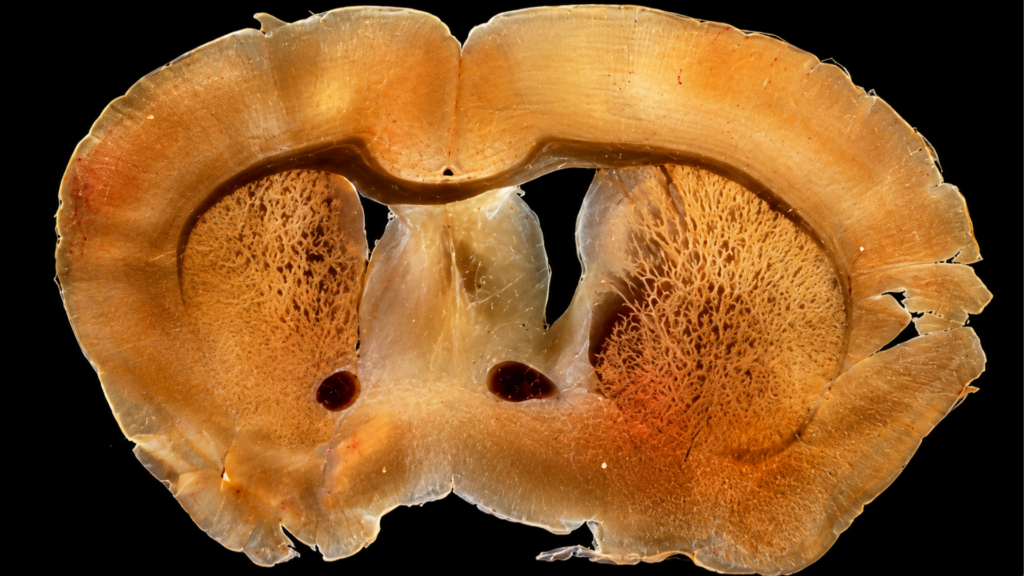
Hersam’s team partnered with Indira M. Raman, the Bill and Gayle Cook Professor of Neurobiology at Northwestern, to test the device against biology. Raman’s team applied electrical signals from the artificial neuron directly to slices of a mouse’s cerebellum, the part of the brain responsible for coordinating movement. Instead of measuring circuits on a screen, the researchers watched to see if actual living brain tissue would react to a printed piece of electronics.
The artificial voltage spikes matched key biological features, including the timing and duration of the pulses that real neurons fire. Those signals reliably triggered activity in the mouse brain tissue, activating neural circuits in a way similar to natural signals. Hersam described watching the living neurons respond to the artificial one as proof the printed device could speak the brain’s electrical language rather than simply imitate it.
Getting that timing right had eluded other labs for years. Hersam said the team demonstrated signals with not only the right timescale but also the right spike shape to interact directly with living neurons. The result placed the Northwestern device inside a narrow range of electrical behavior that no earlier artificial neuron had reached, marking the first time a printed device matched real brain signaling with this level of precision.
Artificial Synapses Are the Next Step Toward Brain-Like Computers

A working artificial neuron is only one building block. Study co-lead Vinod K. Sangwan, a research associate professor at Northwestern’s McCormick School of Engineering, noted that connecting many of these devices together will require artificial synapses, the links that let real neurons pass signals to one another. Researchers still need components that can form and break those connections the way biological synapses constantly reshape themselves during learning and memory formation.
The payoff would be computing hardware that learns and adapts while using a fraction of the power that today’s AI systems demand. Silicon chips rely on billions of identical, fixed transistors that never change once they are built. The brain relies on diverse, adaptable cells instead, organized across specialized regions. Closing that gap could ease the energy burden that data centers place on power grids and water supplies nationwide.
Northwestern’s printed neuron does not solve AI’s energy problem on its own, but it proves the underlying idea holds up outside a lab simulation. A device built from ink and polymer generated signals precise enough to make living brain cells fire in response. That result gives engineers a physical starting point for building computers modeled on biology rather than brute force, turning a decades-old ambition into a working piece of hardware.