

Products are selected by our editors, we may earn commission from links on this page.
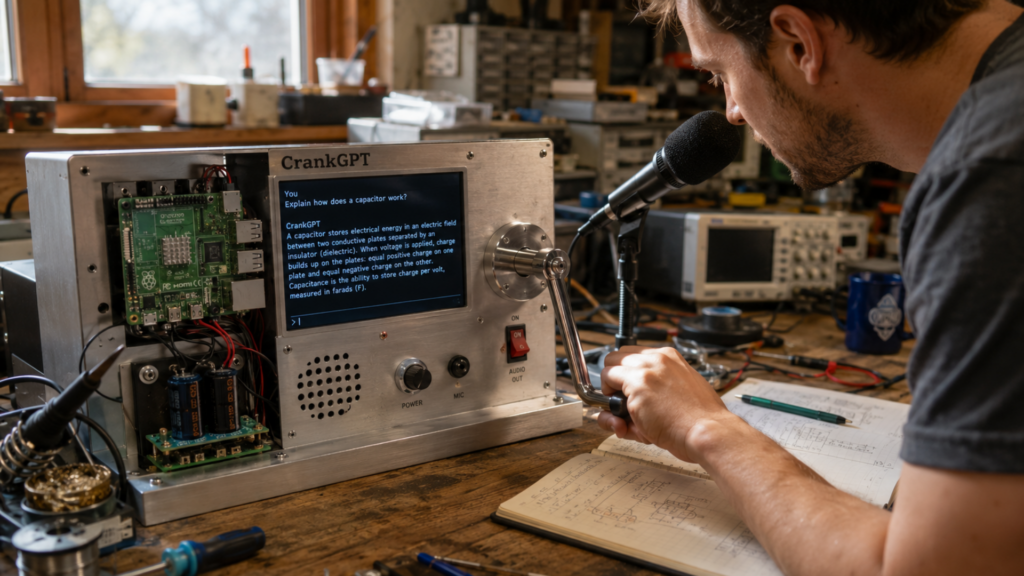
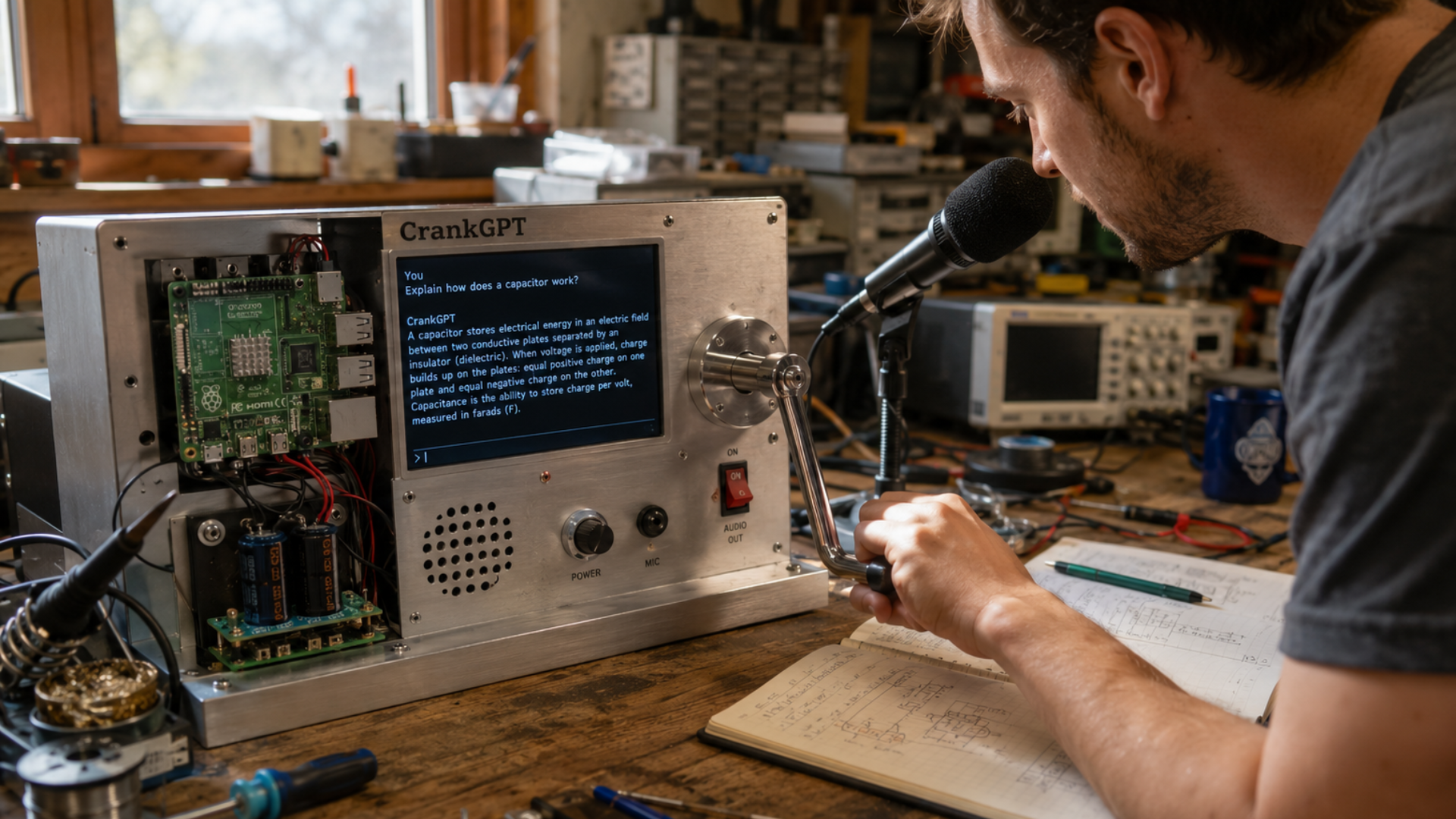
Most AI chatbots require a data center, a reliable power grid, and a monthly subscription. CrankGPT requires none of those things. It requires a working arm. Built by two-person company SqueezLabs, CrankGPT is a self-contained, battery-less device that runs a local language model entirely on power generated by turning a hand crank. No internet connection. No electricity. No cloud.
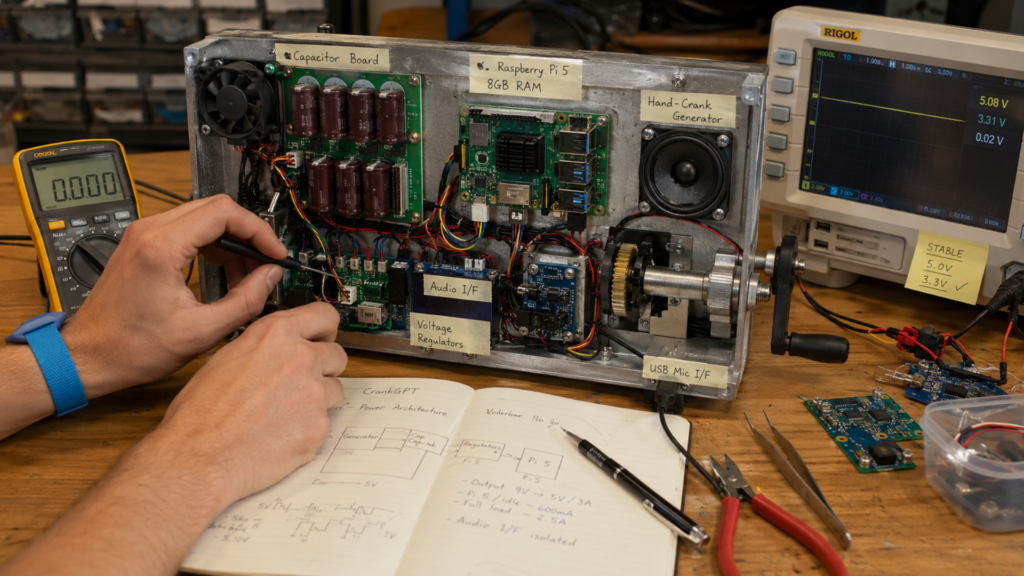
The hardware is modest by design. According to the device’s website, the unit contains a Raspberry Pi 5 with 8GB of RAM, an audio input and output card, and a 20-watt hand-cranked generator. SqueezLabs designed a custom capacitor board to keep the voltage supplied to the Raspberry Pi stable while the crank is in use. The device takes voice input, converts speech to text through a custom voice agent, and reads responses aloud through text-to-speech software called Piper.
SqueezLabs describes its mission as “making AI smaller, cheaper, and faster so you can run it anywhere.” CrankGPT is the clearest expression of that goal yet. It is not a novelty gadget dressed up in survival branding. It is a working proof of concept that a language model can run on the kind of power a person can generate with their own body, in any location, under any conditions.
This article was created with the assistance of AI and reviewed by our editorial team for accuracy and clarity.
AI Has a Power Problem. CrankGPT Shows the Floor Is Much Lower Than the Industry Admits.
The dominant assumption in AI development is that more power means better results. The largest language models run on server farms consuming megawatts of electricity, and the industry has built its scaling roadmap around that premise. CrankGPT does not disprove that assumption at the frontier. It challenges whether the assumption was ever necessary for the vast majority of what people actually use AI to do.
SqueezLabs recommends running small Liquid AI LFM2 variants, at 350 million or 1.2 billion parameters, or Google’s Gemma 3 in its 1 billion parameter form. These are a fraction of the size of models like GPT-4. The tradeoff in capability is real, but for a device designed to answer practical questions in a low-resource environment, the relevant question is not whether the model can write a screenplay. It is whether it can function when nothing else does.
The designers put their reasoning plainly: “It offended our European small-practical-car sensibilities to see people around us throwing kilowatts and thousands of tokens at tasks small models could accomplish just as well as huge ones, for a fraction of the cost and energy.” That critique lands hardest in contexts where efficiency is not a preference but a constraint. Off-grid, in an emergency, or simply without reliable infrastructure, the smallest functional model is the only model that matters.
You Can Feel the AI Thinking Through the Crank, and That Changes What It Means to Use One

CrankGPT makes the cost of computation physically tangible in a way no other AI device does. According to the device’s website, when the language model runs inference and speech synthesis simultaneously, the crank becomes noticeably harder to turn. The user feels the processing load in their hand in real time. That is not a flaw in the design. It is the most honest interface AI has ever had.
Every other AI product on the market abstracts the cost of a response behind a loading spinner or a blinking cursor. The compute happens somewhere else, paid for by someone else, running on power the user never sees. CrankGPT collapses that abstraction entirely. The effort required to get an answer is the effort the user supplies, directly, in the moment the answer is being generated. There is no hiding what it costs.
The device is designed for environments where infrastructure cannot be assumed: off-grid locations, disaster scenarios, or any situation where power and connectivity are unreliable. But the use case that makes it most interesting is not survival. It is what the design reveals about every other AI product by contrast. When the energy source is a human arm, the question of whether a given query was worth the effort becomes impossible to ignore.
The AI Industry Is Scaling Toward Gigawatts. Two People in a Garage Built Something That Runs on You.

The scale gap between CrankGPT and mainstream AI development is not a matter of degree. It is a fundamental difference in direction. Major AI labs are negotiating multi-gigawatt power agreements, pursuing dedicated nuclear capacity, and building data centers the size of small cities. SqueezLabs built a device that runs on 20 watts of human-generated power, deliberately, as a statement about what the industry is choosing to treat as necessary.
That choice has consequences that extend beyond any individual product. AI’s projected energy demand is one of the most significant infrastructure challenges facing the U.S. power grid over the next decade. The compute requirements for frontier models are doubling at a pace that outstrips the grid’s ability to expand. The efficiency that SqueezLabs demonstrated with CrankGPT is not a curiosity. It is a reminder that the industry’s energy trajectory reflects decisions, not physics.
CrankGPT will not replace the models that power enterprise software, medical research, or large-scale data analysis. That is not what it is trying to do. What it demonstrates is that a working, voice-activated AI assistant can run on the output of a single human arm, with off-the-shelf components, built by two people. The industry has spent years arguing that scale is the only path to capability. SqueezLabs built something capable and asked what scale was actually for.