


Products are selected by our editors, we may earn commission from links on this page.

A clause buried in the U.S. Constitution, rarely discussed outside law school classrooms, has suddenly become the most searched political term in America. The 25th Amendment, a post-Kennedy assassination safeguard that allows a president to be removed if deemed unfit for office, is no longer just a talking point. Prediction markets now place the likelihood of Trump’s removal via the Amendment at 39%, one of the highest levels recorded since he returned to office. That number is moving fast.
What is driving the spike is not just partisan noise. The surge follows a wave of public concern being tracked in real time on Kalshi, one of the largest regulated prediction markets in the United States, where trading volume climbed steadily as users placed bets on whether Cabinet-level action to declare the president unfit might actually occur. Former officials, sitting senators, and even some former allies are now openly calling for the Cabinet to act. The conversation has clearly crossed a threshold.
The prediction market contract on Kalshi, titled “Will the 25th Amendment be used during Trump’s presidency?” started at 15% in January 2025 and has since climbed to 35.1%. It is a number that, while still reflecting uncertainty, signals something has fundamentally shifted in how Americans are reading the current political moment. What exactly pushed it this far?
The Easter Post That Changed Everything
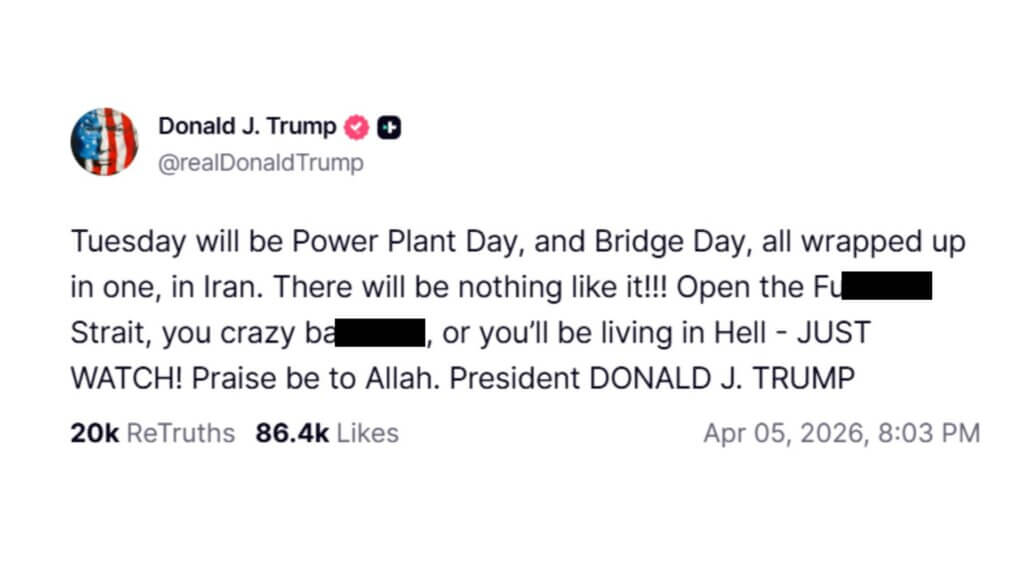
The trigger was a single Truth Social message posted on Easter Sunday. Trump wrote: “Tuesday will be Power Plant Day, and Bridge Day, all wrapped up in one, in Iran. There will be nothing like it!!! Open the F*****’ Strait you crazy b*******, or you’ll be living in Hell — JUST WATCH! Praise be to Allah.” The post landed like a grenade across Washington, instantly drawing responses from lawmakers on both sides of the aisle and reigniting fears about the president’s state of mind during an active war.
The backlash was swift and broad. Democratic Senator Chris Murphy of Connecticut wrote on X that if he were in Trump’s Cabinet, he would “spend Easter calling constitutional lawyers about the 25th Amendment,” calling the post “completely, utterly unhinged.” Senate Minority Leader Chuck Schumer described Trump as “ranting like an unhinged madman,” and Senator Bernie Sanders called the message “the ravings of a dangerous and mentally unbalanced individual.” The condemnations were not limited to Democrats.
Even former Trump ally Marjorie Taylor Greene broke ranks publicly, writing on X that Trump “has gone insane” and urging administration officials to “intervene in Trump’s madness,” adding that everyone around him is “complicit.” That a staunch Trump loyalist issued such a statement underscores just how alarming the post was received, even within the president’s own orbit. But for the 25th Amendment to matter, it needs more than outrage. It needs the Cabinet.
What the 25th Amendment Actually Requires
The 25th Amendment is not a simple recall vote. Section 4, in which the vice president and a majority of the 15-member Cabinet can vote to discharge the president, has never been formally invoked. In practice, it would set off a constitutional chain reaction unlike anything the United States has ever seen. Understanding what it actually takes to trigger this mechanism is essential to measuring how realistic this moment truly is.
If the vice president issued such an order with a Cabinet majority, they would assume the president’s role and inform Congress of the decision. Trump would then likely immediately contest that decision, and Congress would hold a vote within 48 hours. It would take a two-thirds vote of Congress to side with the vice president, the same threshold as impeachment. In other words, removing a sitting president this way is designed to be extraordinarily difficult by constitutional intent.
Former White House counsel Ty Cobb, who served under Trump in his first term, said publicly: “Given the fact that the Cabinet will not invoke the 25th Amendment for a man who is clearly insane — this war highlights that and these screeds that come out nightly, you know, at 2 a.m. or 4 a.m. — it highlights the level of his insanity and depravity.” Cobb’s statement is remarkable precisely because he is not a political opponent. He served this president, and now he is calling out the Cabinet’s silence. So why isn’t the Cabinet moving?
The Loyalty Wall and What Comes Next
The most critical obstacle to any 25th Amendment action is not Congress. It is the Cabinet itself. The political reality is that it is exceedingly unlikely Trump would be removed by a Cabinet that includes loyalists such as Attorney General Pam Bondi, Defense Secretary Pete Hegseth, and Homeland Security Secretary Kristi Noem. These are officials who have tied their careers and political futures to this president. None has indicated any appetite for a break.
There is currently no evidence that Vice President JD Vance or Cabinet officials are preparing to invoke the 25th Amendment. Vance has been a firm supporter of the president and has given no indication that he has any plans to try to remove Trump from office. Republicans in Congress have also shown little appetite for actions that would destabilize their own administration. For now, the wall of loyalty holds, even as the public conversation grows louder and the prediction market numbers keep climbing.
The repeated resurfacing of the 25th Amendment reflects deeper unease among some critics about presidential power and accountability. Similar conversations emerged during Trump’s first term, including references in a 2018 anonymous New York Times op-ed to early Cabinet discussions about the amendment, though no action followed. Whether history repeats itself, or whether this moment is genuinely different, will depend on how the Iran war unfolds and whether anyone inside the administration blinks first. For now, the markets are watching. So is the world.