


Products are selected by our editors, we may earn commission from links on this page.

The bitter shock of discovering your tech career has been permanently eliminated by an automated corporate restructuring script is an immediate disaster that middle class families across Silicon Valley are actively facing today. This economic crisis materialized for long term software engineers when regional technology executives began executing massive corporate downsizings to fund next generation artificial intelligence development. These highly paid professionals, who previously enjoyed stable household salaries, now watch their personal financial stability vanish as multi billion dollar conglomerates aggressively reduce their human headcounts.
The underlying industrial conflict escalated rapidly after legislative representatives began responding to mounting public anger over concentrated corporate power. According to detailed economic research logs compiled by Chapman University presidential fellow Joel Kotkin alongside labor statistics verified by economist Gad Levanon, major technology enterprises have systematically automated their operations while reporting record setting corporate earnings. This widening operational gap has forced regional lawmakers to aggressively pursue new tax frameworks designed to capture massive private cash hoards, directly challenging the political influence of Silicon Valley’s established corporate elite.
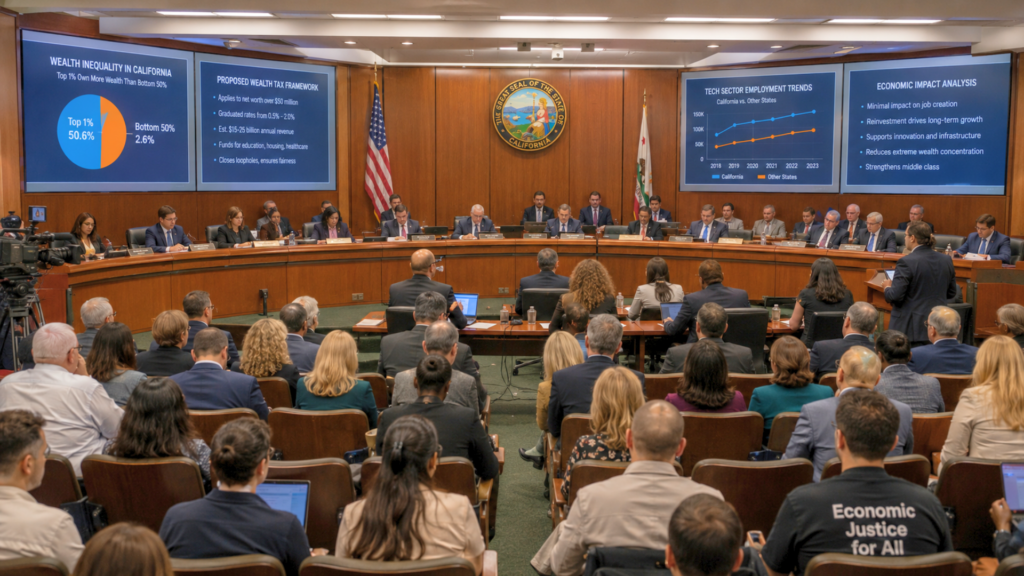
The immediate transactional scale of this economic contraction involves a sharp reduction in California’s share of high tech employment, which dropped from 19 to 16 percent since 2022. That 3 percent workforce reduction represents the permanent loss of tens of thousands of above average salaried jobs, a labor collapse larger than the entire active manufacturing workforce of multiple midwestern states combined. For an ordinary worker, this corporate shift means navigating the highest cost of living adjusted poverty rate in the nation while local housing markets become completely unaffordable.
When Automated Corporate Redundancy Outlasts Initial Promises of Employee Protection

Modern industrial development frameworks regularly prioritize automated software expansion over the explicit economic stability of local municipal workforces. Under current corporate management strategies, major technology conglomerates are aggressively slashing baseline payrolls to maximize raw computational efficiency and satisfy institutional investors. Data compiled by regional labor groups demonstrates that while corporate executives enjoy unprecedented financial returns, the broader civilian population suffers from chronic job scarcity in sectors that traditionally provided upward mobility for working families.
Corporate executives from dominant digital platforms have publicly defended their ongoing operational realignments, issuing formal declarations stating that artificial intelligence investments are essential for maintaining global technological competitiveness. Representatives from these multi billion dollar enterprises assert that these structural shifts will eventually generate secondary employment ecosystems across the domestic economy. However, independent labor advocates counter that the immediate consequence of these massive workforce reductions is the permanent erosion of high paying, stable careers for everyday middle class professionals.
The physical fallout of this rapid industrial contraction forces local communities to absorb the immense infrastructural burdens of an increasingly automated tech sector. In major metropolitan zones, residents now face severe functional illiteracy challenges alongside a total lack of newly created above average paying positions. This systemic failure ensures that a family’s daily survival is no longer anchored by a robust local job market, but rather by volatile service economies that fail to cover basic monthly utility bills.
How Excessive Capital Relocation Fractures Regional Municipal Housing and Utility Structures

The secondary complications of these massive corporate payroll reductions extend deep into the domestic political landscape, transforming routine state legislative sessions into an intense ideological battleground over private asset distribution. Public opinion logs demonstrate that everyday citizens are growing increasingly disapproving of billionaire lifestyles, which feature massive private yachts and numerous mansions, while regional public services deteriorate. This escalating civil friction has forced progressive lawmakers to introduce sweeping legislation aimed at establishing a permanent 5 percent annual wealth tax on billions in assets.
Coordinated community adjustments have intensified across the West Coast as independent policy watchdogs expose how the wealthiest corporate directors previously funded the exact political factions now demanding their financial compliance. For instance, recent campaign disclosure logs show that technology employees and corporate political action committees donated millions of dollars to progressive legislators during recent national election cycles.
This deep political investment shows that the tech industry’s historical attempts to buy regional political favor have ultimately failed to shield their assets from popular tax initiatives. “Texas is the undisputed headquarters of headquarters. The world’s leading businesses invest with confidence in Texas because of our welcoming business climate, predictable regulatory environment, and skilled and growing workforce. People and businesses are choosing Texas because Texas works.”
Why Abstract Industrial Decentralization Leaves Family Financial Portfolios Permanently Vulnerable
The long term structural fallout of this intense state level political friction threatens to permanently alter the baseline of American technology regulation and weaken traditional corporate tax exemptions. Federal energy monitors are increasingly concerned that the immense power demands of newly constructed artificial intelligence server clusters will permanently overload regional utility grids. If massive technology firms continue to expand their dense data complexes without securing new energy infrastructure, neighboring suburban communities will face skyrocketing residential electricity costs.
This current infrastructure crisis mirrors previous historical cycles where massive commercial enterprises externalized their operational expansion costs directly onto the physical environment of developing regional communities. From the early proliferation of unregulated telecommunication networks to the modern expansion of water hungry data cooling facilities, local neighborhoods consistently absorb the long term structural damage. Federal commerce regulatory bodies remain slow to impose uniform resource caps, leaving individual municipalities to unilaterally negotiate the terms of massive corporate infrastructure placement.
The silent friction between aggressive wealth redistribution initiatives and defensive corporate relocation strategies continues to reshape the American domestic landscape without any overarching public resolution. Families living within these transforming technology hubs face an uncertain future where a corporate executive’s automated payroll decision dictates local tax revenues and public school funding. No centralized agency has established mandatory protections for workers displaced by rapid machine learning integration, forcing millions of ordinary households to carry the permanent burden of an endless economic experiment.