

Products are selected by our editors, we may earn commission from links on this page.

Thursday, Nov. 12: millions of workers lose access to Outlook. Friday: flight departures across the country come to a halt. Monday: payments between major banks slow to a crawl. Tuesday: iPhone owners find iCloud and Apple Pay locked. In under a week, a run of high-profile failures left Americans rattled, and officials say there is no sign of a hack behind any of them. The explanations that emerged over the following days had something unsettling in common.
The first domino fell around midday on Nov. 12, when Outlook, Teams and Copilot stopped working for users around the world. Downdetector received about 130,000 Outlook problem reports at the start, according to USA TODAY. Workers joked about an unplanned adult snow day. Microsoft quickly said the cause was a technical issue unrelated to cyber threats or AI agents. The full explanation took days to arrive, and it pointed to a date months earlier.
The next afternoon, the shock moved to the sky. At about 3:30 p.m. ET on Friday, Nov. 13, the Federal Aviation Administration ordered a nationwide ground stop, the first since January 2023. Airports from Atlanta to New York filled with stranded passengers. Online, one user begged to be woken up when “this timeline” was over. Behind the scenes, investigators were already tracing the problem to an unlikely place.
A Nationwide Ground Stop Left Airlines With a $345 Million Bill and Investigators Searching for Answers
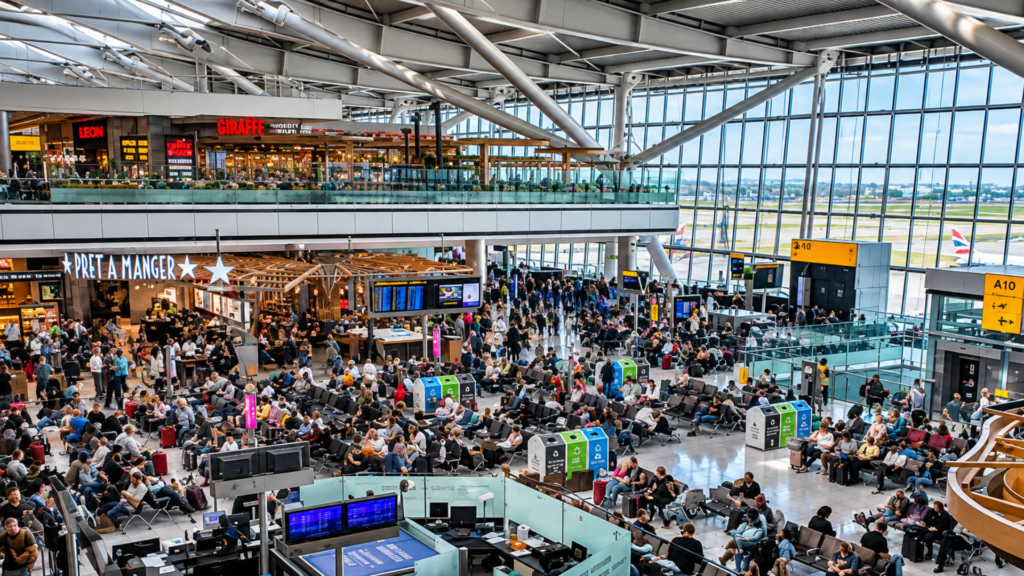
The stop lifted in the evening, roughly five hours after it began, but the damage was done. The FAA later said operators canceled about 12,462 flights, including 9,082 by major airlines, though not every cancellation traced directly to the stoppage. Transportation Secretary Sean Duffy told reporters the country relies on “an incredibly old air traffic control system,” and said its equipment began feeding controllers inconsistent data. The answer to what triggered that pointed to something installed only days earlier.
Wall Street put a price on the chaos. Analysts at Bernstein estimated the ground stop and the weekend recovery cost American, Delta, United and Southwest a combined $345 million, with American absorbing $113 million of it. Thirteen Democratic senators urged the FAA to halt new router installations, and Duffy asked Congress for $50 billion to modernize the system. The agency did pause installations, but only after tracing the trouble to a single device.
According to the Associated Press, a new router installed by contractor L3Harris in El Dorado, Arkansas, disrupted communications and radar feeds at 17 of the FAA’s 22 regional control centers. The FAA said another router installed three weeks earlier in Amarillo, Texas, had also malfunctioned. Duffy noted that 68 earlier installations of the same routers went smoothly. Hewlett Packard Enterprise, which owns the router’s maker, said the device worked as configured, a statement that pointed toward the installer.
Microsoft Blames a Bug From July While Chase Points to Its Own Software

Microsoft’s preliminary report, dated Nov. 15, traced its outage to a defect introduced with a July update to the networking gateway servers that front many Microsoft 365 services. That update passed load testing and ran without incident worldwide for more than three months, The Register reported. Engineers saw nothing wrong with it until two separate conditions arrived at the very same moment.
A routine shift of Teams traffic sent a surge toward the gateways just as a separate problem earlier in the week had trimmed server capacity. Under that strain, the dormant flaw took hold, and more than 80% of gateway servers stopped responding in under two hours, according to the company. So many machines failed at once that standard recovery tools could not keep pace. By Monday afternoon, the trouble had reached people’s bank accounts.
On Monday, Nov. 16, JPMorgan Chase customers reported problems with online banking, transfers and some branch services. Downdetector also spiked for Bank of America, Wells Fargo, U.S. Bank and Zelle. Chase blamed a software bug in its on-premises hardware and said cyber activity played no part. Rival banks reported no direct system failures, yet payments touching Chase accounts, including some Zelle transfers, arrived late. Chase said it fixed the issue by about 7 p.m. ET.
Experts See a Common Thread in Failures That Officials Say Are Unrelated

Meanwhile, United Airlines suffered a system outage of about an hour that evening, between 5 and 6 p.m. ET. FlightAware showed 28 cancellations and 811 delays by 9:50 p.m., though many disruptions predated the outage report. On Tuesday, Apple said an internal update knocked out iCloud, Apple Pay and other services until around 5 p.m. ET. Neither company saw signs of a cyberattack. Four of these failures, it turned out, began inside the organizations themselves.
Experts see a pattern in that. Virginia Tech professor Ali Butt told Yahoo Tech that tightly connected systems let a small change spread far past its starting point when nobody maps what lies downstream. Patrick Moorhead of Moor Insights and Strategy found no evidence of a coordinated attack, but said concentration in critical infrastructure means one failure can strike at national scale. Real hackers were busy that week too, targeting web firm Optimizely.
Butt offered a blunt takeaway: “Should people panic? No. Should we ask for better engineering? Yes.” He recommends testing changes for downstream effects, rolling them out in stages and isolating faults. Experts expect dependence on massive-scale technology to keep growing, with failures arriving more often and hitting harder. The FAA is back on older Cisco routers while investigators work. Microsoft’s bug sat harmless for three months after passing load testing, and nothing about it looked dangerous until the moment it was.