


Products are selected by our editors, we may earn commission from links on this page.
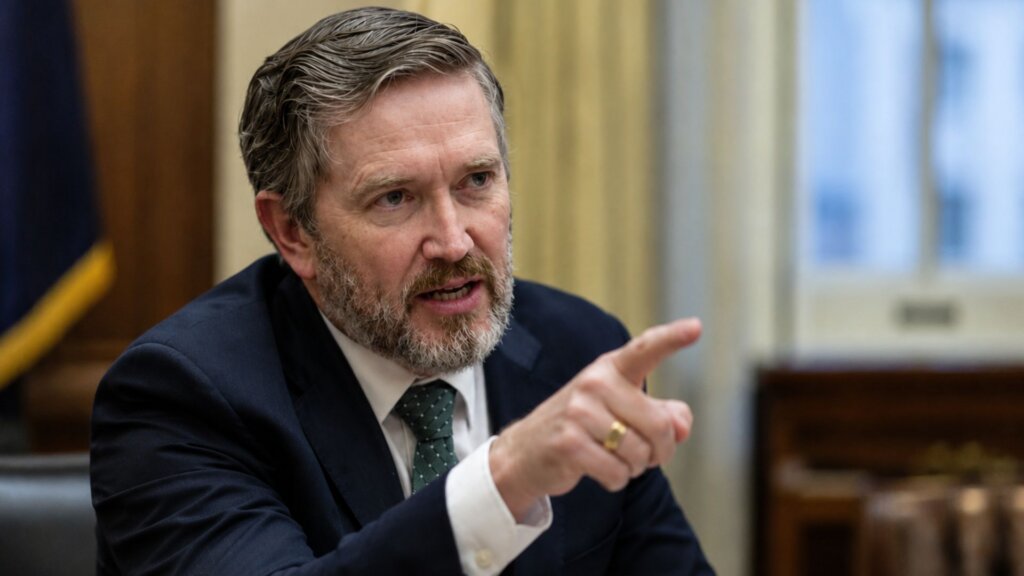
A congressman who lost his primary race is still sounding alarms, and the numbers behind his warning are hard to ignore. Rep. Thomas Massie (R-Ky.), a longtime deficit hawk, posted on X that President Donald Trump’s combined agenda — a sweeping domestic spending law, a war with Iran, and other Republican spending bills — will drive the federal budget deficit to $2 trillion in 2026 alone. For average Americans, the cost may not stop when the fighting does.
Massie’s projection tracks with official estimates. The Office of Management and Budget put the fiscal 2026 deficit at $2.065 trillion, while the Congressional Budget Office pegged it slightly lower at $1.853 trillion. Either figure represents a debt burden far beyond what most Americans encounter in day-to-day life. The gap between those projections, roughly $200 billion, is itself larger than the annual budgets of most federal departments. What fills that gap matters enormously for the cost of living.
The law at the center of Massie’s concern is the “One Big Beautiful Bill Act,” signed on July 4, 2025. The CBO’s final estimate found the legislation will add $3.4 trillion to the national debt over ten years, not counting the compounding cost of interest. A Brookings Institution study put the range even higher, estimating the bill could add between $3.7 trillion and $5.1 trillion to deficits over the same period. That wide spread depends on whether certain provisions are extended or allowed to expire.
A War With No Price Tag, But the Bills Will Arrive
The Iran conflict has added a second, compounding layer to the fiscal picture. Sen. Rand Paul (R-Ky.) put the daily cost of the war at roughly $1 to $2 billion. Sen. Bernie Sanders (I-Vt.) went further, arguing the administration’s official $25 billion estimate is deeply misleading and that the total cost could exceed $1 trillion, amounting to thousands of dollars for every household in America, according to the senator. The Pentagon’s most recent public figure placed the bill at approximately $29 billion as of mid-May 2026.
The gap between those estimates is not merely political disagreement. The first six days of the conflict alone cost an estimated $11 billion, according to the Trump administration’s own disclosures. The Pentagon has since sought more than $200 billion in supplemental funding from the White House to sustain military operations. That request came on top of the nearly $1 trillion Congress had already approved for defense spending in the current fiscal year, a figure that Sanders publicly called out as already excessive before the supplemental request arrived.
What makes the war’s fiscal weight particularly significant is its interaction with existing debt. Higher military expenditures, layered onto a deficit already widened by the Big Beautiful Bill, push Washington deeper into the bond market to finance the difference. That increased borrowing does not stay inside government ledgers. It ripples outward through the financial system, nudging up the cost of money for anyone who borrows — from students and homebuyers to small businesses and local governments.
When Debt Service Eclipses Roads and Bridges

Massie framed the stakes in concrete terms that cut through budget abstractions. According to the congressman, the interest payments on just the new debt created this year will cost more than every federal dollar spent on roads and bridges combined. “Financing just the new debt costs more than all federal road and bridge projects, and we will be making those new interest payments each year, forever,” Massie stated in his post on X. The word “forever” is deliberate: debt interest, unlike a one-time expenditure, does not expire when a program ends or a war concludes.
This distinction matters because the federal government cannot simply stop paying interest on existing debt without triggering a default. Once borrowed, that money must be serviced, year after year, regardless of which party holds power or what else competes for budget space. The CBO’s own analysis of the Big Beautiful Bill projected that interest costs alone from the legislation would add $718 billion on top of the primary deficit increases over the 2025–2034 window, a figure that grows with every additional dollar borrowed.
The crowding-out effect that results from this level of borrowing is not theoretical. The CBO noted explicitly that larger deficits reduce resources available for private investment and place upward pressure on interest rates. That pressure translates directly into higher borrowing costs across the economy. Mortgage rates, auto loans, credit card rates, and business lending all tend to rise when the government competes more aggressively with the private sector for available capital.
The Quiet Toll on Household Budgets

The consequences are already showing up in consumer lending. Federal student loan rates for the 2026–27 academic year are projected to climb across every borrower category. Undergraduate rates are expected to rise to 6.52% from 6.39%, graduate rates to 8.07% from 7.94%, and Parent PLUS loan rates to 9.07% from 8.94%, according to analysis by higher education expert Mark Kantrowitz. These are not large jumps on their own. But they arrive on top of rates that are already elevated, and they compound over the life of a loan.
Economist Justin Wolfers has warned that Americans could face what amounts to an informal “Iran tax” for years, as elevated oil and gasoline prices driven by regional instability continue pressing household budgets. That cost is separate from, and runs parallel to, the debt-driven interest burden Massie described. Two distinct fiscal pressures — one from a domestic spending law, one from a foreign conflict — are converging on American consumers at the same time.
Massie lost his primary race in May 2026, ousted in part because of his opposition to the Iran war and the Big Beautiful Bill. His warnings, however, did not go with him. The debt he warned about is now law. The interest payments he described as permanent have already begun accruing. When a government borrows at this scale, the cost does not disappear when the debate moves on — it simply becomes the baseline from which every future budget starts.