


Products are selected by our editors, we may earn commission from links on this page.

America’s economy keeps expanding, but the paychecks of everyday workers aren’t keeping pace with it. New research from the Federal Reserve Bank of New York shows workers now receive the smallest share of national income since the government began tracking the measure in 1947. The shift has been building for decades, reshaping how millions of families experience a country that looks prosperous on paper.
Workers’ Share of National Income Has Hit a Record Low

Workers took home 54.1% of national income, a gauge known as the labor share of income, in early 2026, according to the New York Fed’s analysis, down from more than 65% when record-keeping began after World War II. The figure stood at 57.7% in early 2020, meaning the decline has continued even as the broader economy recovered from the COVID pandemic and kept expanding steadily through the years that followed.
Most Americans Say Their Paychecks Aren’t Keeping Up

The numbers line up with how many Americans say they actually feel. Roughly 48% described their financial situation as worse than a year earlier, the highest share since January 2023, per a New York Fed survey. A separate CBS News poll found three in four Americans believe their income isn’t keeping up with inflation, while the same poll found only about 29% called the economy strong.
Corporate Profits Are Outpacing Employee Paychecks

A related measure tells a similar story inside corporate America. Workers received 71.3% of corporate income in the first quarter of 2026, down from 77.8% at the start of 2020 and 79.1% in 1979, according to the Economic Policy Institute. That leaves a growing portion flowing to shareholders and executives through profits, dividends, and stock buybacks rather than employee paychecks.
Growing Firms Aren’t Passing Gains to Their Workers

Josh Bivens, chief economist at the Economic Policy Institute, told CBS News that many workers are employed by companies that are thriving without passing those gains along to staff. He noted that people often look back after a decade on the job and feel stuck in place, even as the companies employing them have grown far faster than their paychecks.
Union Decline and a Stagnant Minimum Wage Play a Role
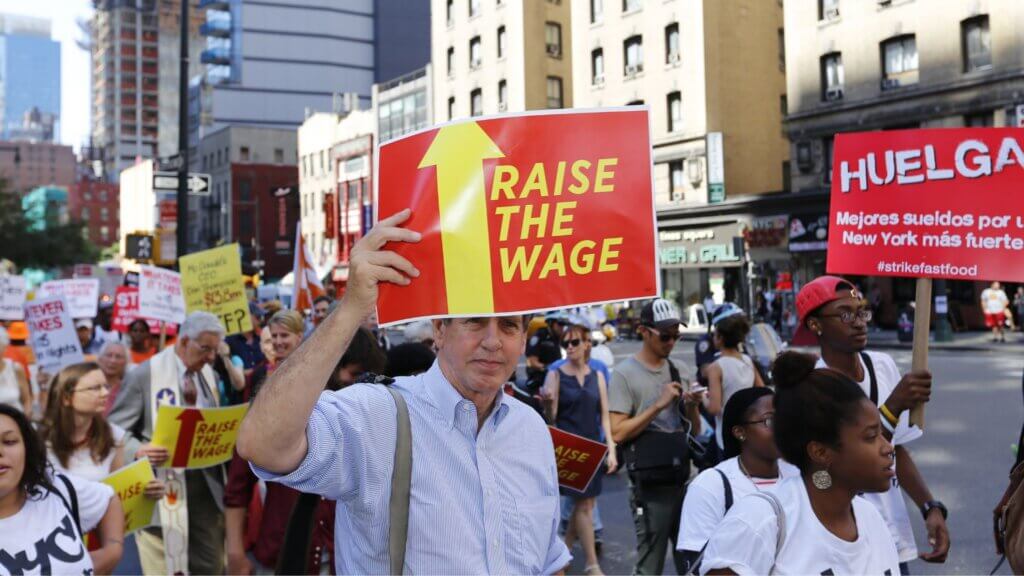
Several long-running forces are behind the shift, economists say, including the decline of organized labor. Union membership fell to just 10% of U.S. workers last year, down from 20% in 1983, per the Center for Economic and Policy Research. The federal minimum wage, unchanged at $7.25 an hour since 2009, is now at its lowest inflation-adjusted value in roughly 50 years, Bivens noted.
Economists Point to a “K-Shaped” Divide

Angela Hanks, chief of policy programs at the Century Foundation, said the trend helps explain today’s so-called K-shaped economy. Where those already doing well keep pulling further ahead while most other households fall further behind. As labor’s share shrinks, she said, workers lose leverage to negotiate for higher pay, which in turn makes it easier for capital to keep the upper hand.
Inflation and Debt Are Adding to the Squeeze

Other pressures are compounding the strain on households. Inflation hit its highest level in more than three years this past May, and a Gallup poll found that two-thirds of households have faced financial hardship from high gas prices. Some families are leaning on credit cards and auto loans just to keep up with costs, and delinquencies on that debt have climbed to their highest point in 15 years, Hanks said.
Is the Decline New, or Part of a Longer Pattern?

A Federal Reserve Bank of New York blog post took a closer look at whether the post-pandemic drop marks something genuinely new. Researchers found that the labor share’s trajectory largely mirrors past recessions. Its decline stems almost entirely from changes within individual industries rather than shifts in which sectors produce output, suggesting the pattern isn’t unique to the pandemic era after all.
A Growing Economy, but a Shrinking Piece for Workers

The gap isn’t likely to close on its own. The economy keeps growing, and corporate profits and executive pay keep climbing, but workers’ paychecks just aren’t keeping up. This trend has been building for years and shows little sign of reversing anytime soon. Even as output and hiring keep rising, an ever-shrinking share of that growth is landing in workers’ pockets.