


Products are selected by our editors, we may earn commission from links on this page.

The shifting landscape of American military commitments in Europe has taken a dramatic turn, highlighting the complex intersection of personal diplomacy, domestic defense budgeting, and transatlantic security. President Donald Trump has announced the deployment of 5,000 additional U.S. troops to Poland, a move that introduces fresh variables into the strategic posture of the North Atlantic Treaty Organization (NATO). This sudden declaration has captured national attention in the United States, as lawmakers and defense analysts weigh how sudden executive directives influence long-standing security alliances and American geopolitical leverage in Eastern Europe.
The announcement emerged directly from executive social media channels, positioning the troop movement as a direct result of the positive relationship between President Trump and Poland’s right-wing populist President Karol Nawrocki, who assumed office following his election in June 2025. This decision arrives on the heels of major diplomatic friction between Washington and other Western European partners, notably Germany. Earlier this month, President Trump announced the withdrawal of 5,000 U.S. troops from Germany following public remarks by German Chancellor Friedrich Merz regarding American military strategies in the Middle East, a dispute that abruptly altered the distribution of American forces on the continent.
The immediate operational impact of the directive remains subject to intense scrutiny, with defense officials working to clarify the origins and timeline of the designated 5,000 personnel. This flashpoint follows a recent Pentagon order that effectively reduced the U.S. presence in Europe by approximately 5,000 personnel, creating a complex logistical calculus where the new deployment may simply offset recent cancellations. Poland currently hosts a baseline of roughly 10,000 American service members, serving as the primary logistics hub for Western humanitarian and military initiatives in the region since 2022.
This article was created with the assistance of AI and reviewed by our editorial team for accuracy and clarity.
The Mechanics of Transatlantic Rotations and Pentagon Reversals
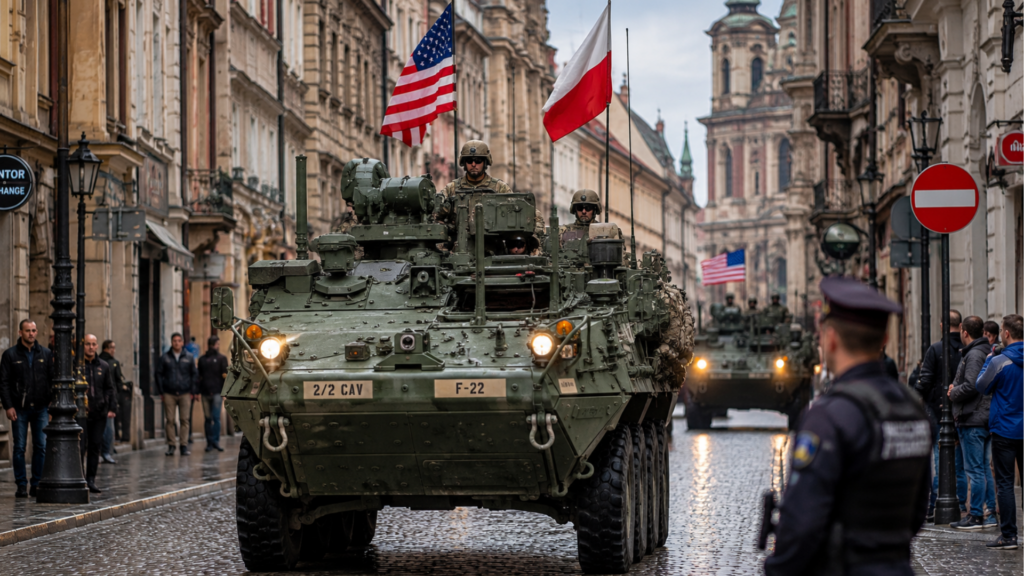
The strategic friction underlying this deployment stems from a recent, abrupt policy shift enacted by Defense Secretary Pete Hegseth. One week prior to the president’s announcement, the Pentagon issued a formal memorandum halting the scheduled rotation of the 2nd Armored Brigade Combat Team, 1st Cavalry Division. This unit, comprising roughly 4,700 soldiers, was slated to rotate through Poland, Romania, and the Baltic states to reinforce NATO’s eastern flank. The Pentagon defended the cancellation by expressing institutional frustration with European nations that officials argue have failed to meet baseline defense expectations during critical global contingencies.
In tandem with the brigade cancellation, the Pentagon memorandum dissolved a future deployment to Germany involving a specialized long-range rocket and missile battalion consisting of over 500 soldiers. The directive further ordered the removal of the European-based command structure overseeing those specific long-range strike capabilities. These systemic reductions triggered immediate pushback from Capitol Hill, where lawmakers criticized the Department of Defense for executing major force-posture changes without formal congressional consultation, leaving key regional allies to navigate sudden gaps in planned security frameworks.
The physical infrastructure of the U.S. military footprint in Poland relies heavily on U.S. Army Garrison Poland, established at Camp Kosciuszko in Poznan in 2023 to solidify permanent logistics and command capabilities. The cancellation of the armored brigade rotation forced personnel who had already arrived on the continent to halt operations and prepare for redeployment back to the United States. This structural whiplash highlights the administrative challenges of translating rapid executive announcements into cohesive field operations when military infrastructure is already configured for long-term, predictable rotational schedules.
Allied Responses and Congressional Scrutiny on Kinetic Posturing
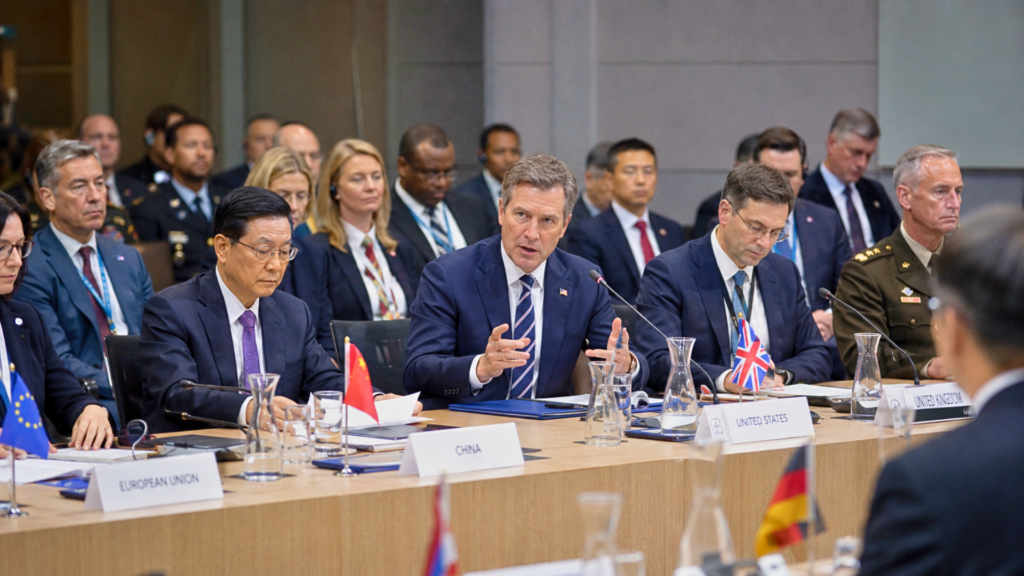
The diplomatic fallout from the announcement prompted immediate damage control and alignment efforts among NATO defense and foreign ministers during an alliance meeting in Sweden. Polish government officials moved quickly to reassure the public and stabilize expectations, framing the U.S. executive announcement as a preservation of status quo capabilities rather than an unprecedented escalation. Polish Defense Minister Władysław Kosiniak-Kamysz publicly noted that Poland would maintain its baseline security architecture, affirming that the nation was not losing its existing contingent of approximately 10,000 American soldiers.
Concurrently, U.S. Secretary of State Marco Rubio sought to contextualize the policy shifts within a broader, long-term optimization of American global assets. Speaking to reporters, Rubio emphasized that the adjustments were part of an ongoing, coordinated effort to marshal resources effectively across multiple theaters of operation rather than a punitive measure directed at specific allies. NATO Secretary General Mark Rutte welcomed the affirmation of U.S. commitment but reiterated that the long-term trajectory of the alliance must focus on building a stronger, more self-reliant Europe that decreases its structural dependency on a single partner.
“All’s well that ends well,” stated Polish Foreign Minister Radosław Sikorski as he addressed reporters in Sweden, highlighting Warsaw’s relief that the baseline of ten thousand American troops would remain secure despite initial administrative confusion. This high-stakes reassurance aimed to calm anxieties across European defense circles, projecting stability to international observers after a week of intense systemic friction and sudden military policy reversals between Washington and its continental allies.
Long-Term Systemic Fallout and the Future of Transatlantic Governance

The sudden pivot in U.S. force distribution underscores a broader transformation in how Washington manages its international defense treaties and bilateral agreements. By explicitly linking military movements to the election of specific foreign leaders, the current doctrine introduces a highly personalized model of statecraft that challenges traditional, institutionalized defense planning. This approach risks complicating long-term defense budgeting and strategic forecasting for both the Pentagon and international partners who rely on predictable, multi-year troop commitments to deter regional security threats.
This incident fits into a larger, ongoing historical pattern of shifting American priorities regarding overseas military spending and burden-sharing debates within NATO. The tension between executive directives and congressional oversight remains a primary constitutional friction point, as lawmakers seek to assert their authority over defense appropriations and foreign policy deployments. The cancellation of pre-planned rotations without prior legislative briefings has intensified the debate in Washington over the boundaries of executive control over military personnel assignments.
As the implementation details of the 5,000-troop deployment materialize, the future of digital governance, international trust, and alliance cohesion will depend on how cleanly the United States balances bilateral enthusiasm with collective treaty obligations. The contrast between public executive declarations and internal Pentagon administrative orders highlights the necessity for clear, transparent communication channels between Washington and its allies. Moving forward, the true metric of success for American deterrence strategy in Europe will not merely be the raw number of troops stationed abroad, but the institutional stability and predictability of the alliances that support them.